Posts tagged: Recruiting Top Talent

Two Types Of Recruiters – Retained and Contingent

90% of recruiters fall into one of two categories, they are either retained or contingent. The difference is significant and a candidate should know the difference so that they know what to expect from each. Granted there are other types, but they are few and one rarely encounters them.

Since September of 1980 I have been an executive recruiter. I still run an executive search firm, IMPACT Hiring Solutions. For the first 13 or 14 years I was a contingent recruiter and since then have been a retained recruiter. Having worked both sides of the street, I will explain the difference and why it is so critical as a candidate that you know which type of recruiter you are working with so you can properly set your expectations. I hope this will reduce some of the frustration in dealing with recruiters.  I know it will not eliminate it.

As a starting definition:

1) Contingent recruiters get paid when the candidate starts working. Until then they are working for free. Think of them as a 100% commission sales person. No sale no income.

2) Retained recruiters get paid by progress in the search.  This payment stream varies by agreement between the company and recruiter, however, as a general rule it is the first third of the projected fee to begin the search, the second in some period of time usually 30 – 45 days, and the final third when the person starts or in some agreed upon time frame. The retained recruiter is guaranteed, if not all of the fee, at least two thirds regardless of whether a person is hired or not. Much like a lawyer or tax accountant, the fee is independent of the results.

One is no better than the other and both serve a purpose and market. Either type of recruiter can be professional and unfortunately unprofessional. There is no rule that guarantees that you will get a highly skilled and professional recruiter with either type, anymore than you can with a lawyer, accountant, counselor, or any other profession. There are good and bad in all professions.

So what should you expect from each of these and how does this differ in the real world and the day-to-day workings of each type of recruiter?

First some ground rules: 1) This is “Recruiters 101″ so I will not be able to cover every aspect and every situation. 2) This is an overview, so I will be discussing generalities. There are exceptions to everything. 3) Unless otherwise specified, I will be assuming a professional recruiter and not the flakes that are out there. 4) Don’t confuse recruiters with career counselors or coaches, resume writers or outplacement consultants. There is a big, big difference in all of these. 5) When possible I will try to contrast the two to help you understand what to expect from each.

Contingent Recruiters

Since they are basically 100% commission sales people, closing the sale is critical and so is time. When a company uses contingent recruiters, most of the time they engage more than one. Depending on the discipline and geographical area, that could be up to 10 recruiters working the same position. The company is also attempting to fill the position so the recruiter is not only competing against other recruiters but also the company.

Time is critical to contingent recruiters. The first recruiter to get the resume to the company is considered the recruiter of record and the one that will get the fee if that candidate is hired. Since candidates send their resume to multiple recruiters, having an inventory of candidates is critical. A good contingent recruiter wants active candidate’s resumes on file so that the minute a company calls with a job opening the recruiter can email resumes  before another contingent recruiter working with the same candidate can. This makes them the recruiter of record. From a candidate’s perspective, don’t send your resume to just any recruiter if you don’t want it sent out to companies without your knowledge. Contingent recruiters don’t want to take the time to call or email you, wait for a return call or email, to find that while they are waiting some other recruiter emailed your resume to the company.

Over screening resumes is the worst thing a contingent recruiter can do.

Contingent recruiters may or may not meet the company and hiring manager. This is not a requirement for contingent recruiters. Some will and some won’t. I always met every candidate before sending them out to a company. They may not have even been to the company, or ever met the hiring manager, so as a candidate you may not be able to expect all of your questions about the company, position, and future boss to be answered.

Retained Recruiters

Since retained recruiters get paid regardless of the outcome, they aren’t as driven by time as much as match. Retained recruiters generally have much longer guarantees so it is very important that the candidate is successful. For example, we have up to a year’s guarantee.

Retained recruiters are expected to be very selective. This is frustrating to candidates that think they are qualified, but the retained recruiter isn’t impressed. A big mistake candidates make is that they assume retained recruiters are looking for qualified candidates.  Retained recruiters aren’t looking for qualified candidates. The company can do that on their own. Retained recruiters are looking for exceptionally qualified candidates that the company can’t find.  As close to perfect as we can get.

Most retained recruiters have a very close working relationship with the company and hiring manager. They generally have spent a fair amount of time with the hiring manager, they should have a complete understanding of the position, and know what type of personality works well in this culture and with the hiring manager. Also, most retained recruiters will have an extensive screening process before the candidate moves on to meet the company.

A candidate should expect to be one of  4 or 5 candidates presented to the company for any one position.

The retained recruiter is not competing against other recruiters or the company. They know that if the candidate fails, this may be the last time they work with the company. Generally, they have a long relationship with the hiring manager and that is the person that hired them.

That is Recruiters 101, I welcome your thoughts and comments.

For more, join our LinkedIn Job Search Networking Group. CLICK HERE to join.

To learn more about the retained executive search process CLICK HERE.

If this was helpful to you then please pass it on to others. Consider emailing it to your network, updating it on your LinkedIn or Facecbook status, or mentioning it on Twitter. The more you help the better.

I welcome your comments and thoughts.

Brad Remillard

Don’t Underestimate the Power the Four “A’s” Have On Your Interview

In a previous article, “Leveraging the Power of the First Impression Helps You Win the Interview” we discussed just how critical (not important, critical) the first impression is to the interviewing process. One of the suggestions was to understand the most important points known as the four “A’s.”

These four “A’s” can dramatically impact the interview before the interview even starts. That is powerful.

Each of these must be integrated into your interviewing style and come off as if they come naturally to you.

  • Appearance – This is not just how you dress for the interview, it is much more than that. It includes your body language during the interview, how you sit in the chair, the appearance of your resume and cover letter, the appearance of any materials used during the interview, eye contact, and I hate to say it, but it does include physical appearance.
  • Assertive – This is mostly about how you project yourself during the interview. Please take note, the word was not “aggressive.” There is a big difference between aggressive and assertive. Most interviewers respect an assertive person and dislike aggressive people. Do you come across as confident, do you answer the question with a strong voice, do you engage the interviewer during the interview, do you ask probing questions or just sit there and answer questions, do you mirror the interviewer, does your body language and voice have a strong presence?
  • Affable – Are you friendly, outgoing, easy to communicate with, engaging and even have a sense of humor? Does the interviewer feel comfortable talking with you, are they relaxed and feel at ease, do you have some conversational questions to bring up on the way from the lobby to the interviewing room, do you engage in casual conversation and are you building rapport with the person the second they lay eyes on you?
  • Articulate – How well do you communicate? Do you listen to the question? Are your answers sharp and succinct? Do you have proper language skills, syntax, avoid using the word “like”, proper sentence structure and use of verbs? Do you ramble in the interview to make sure you hit every point in your background or are you able to quickly get to the point? This can be one of the easiest of the “A’s” to master. It takes practice and rehearsing, and you will probably need a coach to help you with this one.

On the surface, as you read these, they seem so obvious. Most are thinking, “I already know this stuff.” This may be true, but I think the purpose of the four “A’s” is to highlight in a very simple way some of the key issues many candidates take for granted. As a result they don’t work on mastering them.

There are a lot of dynamics happening at the same time during the hiring process. The more you can master, the better your chances of getting the green light.

Join our Job Search Networking Linkedin Group. There are over 2700 members and an extensive supply of resources for you to tap into. CLICK HERE to join. Membership is FREE.

We have numerous free downloads on our Web site to help you in your search. Sample cover letters, audio downloads from past radio shows,a transferable skills list, Linkedin Profile Assessment Matrix, and our Job Search Self-Assessment Scorecard. All can be downloaded from our home page. www.impacthiringsolutions.com.

Every Monday at 11 AM PDT listen to our radio show from anywhere in the world on www.latalkradio.com channel 2.

Busted – Age Discrimination Revealed

Anyone that has read the discussions in our Linkedin Job Search Networking Group knows that I am not a big believer in age discrimination. That doesn’t mean I think it doesn’t happen. What it does mean is that I don’t think it happens as frequently as many candidates do. In fact, I believe it is far more rare than most.

Well I am wrong. Age discrimination is alive, living, and doing very well. My last two executive searches prove that I’m wrong and it definitely exists.

I have been retained to fill a CFO and VP Manufacturing search. Both positions are very senior level spots and in two different companies. In a normal search, we will present 4 or 5 candidates to the client before they hire one of them. These two were a little different. I had presented my normal 5 candidates and the client was interested in, but not sold on, a couple of the candidates. They still wanted to see a few more. (By the way as a side journey, in today’s market that is very common. Clients seem to always want to see a few more. After all, there are so many candidates on the market.)

The candidates they liked were all 7 or 8’s on a scale of 1 – 10. They all had 15-20 years of experience and judging from when they graduated from college, ranged in age from late 30’s to mid-40’s. Both of these jobs were very senior, and due to the nature of the challenges facing the companies required a real depth of experience and not just the normal depth one gets in 15-20 years. These candidates just weren’t “mature or experienced” enough were the words the clients used.

As the client requested, I presented 2 more candidates to each company. These last 4 candidates all had no less than 30 years of experience, and all had graduated from college in the late 70’s and early 80’s. You can do the math on their ages. My guess is mid to late 50’s and possibly even 60. To no real surprise my clients each hired one of these 4. The comment the client made to me at some point during the hiring process was, “If I can get a good 3-5 years from them, that is all one can expect in today’s world, and I’m more than fine with that. Hell, I may not even be here in 5 years.”

WOW, a clear case of age discrimination if I ever saw one. The first group was clearly discriminated against due to their age.

Again, before you write me a nasty comment, I agree age discrimination exists. But it works both ways. I also don’t believe every time a person doesn’t get a position, especially more senior candidates, it is age discrimination. Often they are just plain over-qualified for the job, just as these candidates were under-qualified for these jobs.

Part 2 on this topic will be more in-depth as to some other contributing factors that helped the second group win the job. There is hope, and by following the suggestions in part 2, you can avoid age discrimination on either side of the equation.

We provide a large repository of free tools and resources (CLICK HERE FOR LISTING) for candidates of all ages to help you significantly reduce your time in search. Every day of lost wages costs you hundreds of dollars and stress. I personally want to encourage you to spend some time reviewing these. There are audio files (CLICK HERE to enter the audio library), templates, assessments, and articles. The topics cover just about every aspect of the search process, networking, branding, resumes, interviewing, common mistakes, leveraging social networks, etc.

Our bi-weekly Candidate Open Forums are available to all who want to participate. You can speak directly with myself or Barry on the conference calls. Our homepage list the upcoming forums. CLICK HERE FOR LIST.

We are committed to assisting you in your search as best we can. These free resources are the best we can do for now. We have even more ideas coming and all will be free.

What’s the difference between “good-to-great” recruiters and bad recruiters?

Image of Bad Recruiter abusing a job search candidate

There are a few “good-to-great” (to borrow a popular phrase from Jim Collins) recruiters out there. Brad and I have trained thousands of recruiters over the last 25 years. The vast majority I wouldn’t want to work with if they were the last recruiters on Earth. They fall into the category of being a “broker” – pushing paper to make a buck – sacrificing ethics, relationships – all to earn a commission.

Conversely, a good-to-great recruiter exhibits the following 6 characteristics:

1. They are responsive

2. They follow-through on their commitments

3. They have a “trusted-advisor” relationship with their clients

4. They are knowledgeable about their client, the client’s industry, and the role

5. They position themselves as a “consultant” not a slick salesperson or “broker”

6. They have a deep understanding of how to measure talent and ask outstanding questions

Have I missed any important differences between bad and “good-to-great” recruiters. What’s your experience? Do you have a favorite story or recruiter behavior you would like to share with our subscribers?

One of the major mistakes many candidates make in working with recruiters is choosing to work with a bad recruiter. The risks including damaging your reputation, screwing up a job opportunity, and providing you with terrible job search or career advice.

Make sure you use the checklist above to ensure you’re working with a reliable, trustworthy recruiter who you know will “get your back” around issues of confidentiality, salary negotiation, presenting your background to client’s, and protecting your reputation.

We’re in middle of developing a scorecard for assessing recruiters. Share with us your key issue that leads to your love of working with a particular recruiter, or the issue that sends you running in the opposite direction. If enough people share your key issue, we’ll feature it as one of the core assessment categories on our recruiter scorecard.

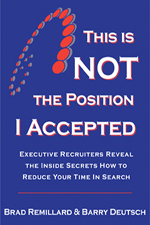
We’ll be giving away a limited number of copies of our popular job search e-book to those who respond before the end of Friday. Shoot us back a quick comment on the blog and share your “burning” recruiter frustration or joy with the rest of our job search community – and perhaps be eligible to win a copy of our e-book based on the original soft-cover workbook, This is NOT the Position I Accepted.

While you’re thinking about your “recruiter issue”, take a moment and check out the extensive list of FREE audio programs we’ve archived on our web site. Every week Brad and I host an Internet Talk Radio show on Mondays 11-noon on LATalkRadio.com, alternating with job search and hiring manager topics. We’ve discussed a few times in the last 6 months various issues of working with recruiters. There are also a series of articles on this blog about how recruiters find candidates and other related topics. Be sure to type recruiter into the search dialog box at the top of the page.

Barry

How to Mistreat Your Recruiter

Job Search Candidate mistreating their recruiter. Why should the recruiter want to help the candidate?


Recruiters also need a little love


Why do many executives and managers mistreat recruiters when they are employed – yet beg recruiters to return their calls and present them on search assignments when they are unemployed or into a major job search for new position?

Is there a touch of irony to this scenario?

Let’s discuss precisely what it means to mistreat your recruiter:

1. When the recruiter calls you to discuss an job opportunity, you don’t return the call, are rude, or slam down the phone impatiently stating you don’t have time to talk.

2. When the recruiter asks you for a referral on an existing search, you indicate that no one comes to mind or you cannot think of one person out of the hundreds you’ve interacted with over the past few years. There is no risk in making a referral – is that not what networking is all about?

3. When the recruiter asks for an introduction to one of your peers or other executives who are looking to employ a recruiter to fill a position, you refuse to make the introduction.

4. When the recruiter who placed you or has worked with you before, calls to check in, buy you lunch, develop a relationship to get to know you better, you drop the phone like it’s a hot potato – why would you want to be caught meeting with a recruiter – wouldn’t that give your peers back at the office something juicy to gossip about?


Brad and I have been conducting executive search for over 25 years. Learn more about one of the most successful Retained Executive Search Practices in this country. We’re highly sought-after speakers, facilitators, and keynoters on the subjects of recruiting, hiring, and job search.

The first people we think of on a new search is “who do I have a relationship with that is an outstanding candidate?”. Our second step is then to start networking through our relationships for candidates we don’t know intimately right now.

What defines a “relationship” with a recruiter. It’s an individual who goes “above and beyond” their peer group in building a long-term mutually beneficial relationship with a a recruiter – one who doesn’t mistreat their recruiter.

Are you guilty of mistreating your recruiter?

Remember – recruiters also need a little love (or at least a pat on the back).

When was the last time you hugged your recruiter?

Barry

P.S: Don’t forget to check out the extensive archives on our site of FREE tools, templates, audio, and examples Brad and I have posted for the candidates who do show us a little love now and then.

Don’t forget to join Brad and I in our LinkedIn Job Search Discussion Group by clicking here for the invitation.

We would like to hear how you’ve either mistreated your recruiter or hugged them by going beyond your peer group to create a relationship.