Posts tagged: Recruiters

How To Get Recruiters To Reply To Your Resume

I know this is one of the major complaints by candidates. I hear it all the time, “I send them my resume and they don’t reply. Most won’t even return my phone call.”  As difficult as it is to say, for the most part these candidates are correct. That doesn’t mean it is right, it just means you are correct.

Similar to most at the manager level and above, when you are working, you are generally overwhelmed with things to do. So you have to prioritize. Some things are high priority and some things go on the low priority list. The low priority items may never get done, or may get done in the next few months. Generally, this depends on what other higher priority items trickle in.

Recruiters are really no different. We have to prioritize our day. Some things are high priority and other things are low priority. If  you want to engage recruiters, your job when working with or contacting them should be to move up the priority list. Knowing how I, and many other recruiters prioritize, might help you do this.

Here is how I set priorities regarding the basic duties as a retained recruiter.  Contingent recruiters might vary slightly, but when I was a contingent recruiter it wasn’t a whole lot different.

High priority:

  1. Clients always come first. So some might ask, “Who is your client?” The company paying my fee is the client, not the candidate. Therefore, the company has first priority on my time. That means I will return their phone calls before a candidate’s, I will meet with them prior to a candidate, reply to their emails first,  and screen resumes they send me first.
  2. Candidates on an active search. These are candidates that I’m actively working with on an existing retained search. They could be at any stage within that search which includes, recruiting ones I have identified, interviewing them, returning their calls or emails, reviewing their resume, meeting them, scheduling interviews, following up after an interview, compensation discussions, reference checking, or basically anything I need to do to move the candidate and the search to the next phase.
  3. Marketing. The next priority for me is marketing. This is meeting with clients and potential clients, attending networking meetings, and making sure I’m out in the market so that when a search comes up I’m the one that gets the call. When that call comes, refer to number 1 above.

Important but not a high priority. These I try to get to by the end of each day. Sometimes they spill over to the next day, but I usually try to complete these within 24 hours.

  1. Returning emails not related to a search from people I know or have worked with in the past. These are generally people updating me on their search, prior clients with a question, a request unrelated to an active search, general emails, and clearing SPAM. Sometimes I don’t get to these until the afternoon. I scan down the “sent from” and subject lines, and when I see someone I know I will read the email and then reply appropriately.
  2. Reply to emails and return calls that are a referral. If someone is referring a person to me, I will always reply. I respect the fact that they have taken the time to do this. I feel I owe the reply out of respect to the referring source.
  3. Return voice mail calls. Basically the same as above. I listen to them and clients get an immediate call. Anything to do with an active search gets a call. Others I evaluate and make a decision on what to do with them. Refer to low priority below for many, not all, of these calls.

Low Priority:

  1. Return emails from those I don’t know. This is one of those low priorities that tick many candidates off. The good news is that you have a much higher chance of getting a return email than a phone call. I often try to catch up on these on the weekend or at night. Because of the large volume of these, I’m often two weeks behind.
    1. If you are just sending me an unsolicited resume, I may or may not reply to you. Generally not. I may take a look at the resume to see if it fits an active search. Probably less than 50% of the time I reply. This is why I preach, tweet, and blog,  DON’T WASTE YOUR MONEY ON A RESUME SERVICE THAT WILL SEND YOUR RESUME TO 1,200 RECRUITERS. Save your money as most recruiters don’t even look at them. I doubt more than 5% of retained recruiters do.
    2. If the email is just to introduce yourself to me with no referral,  I will probably just delete it. What else can I say? Like me or hate me, that is what will happen. (If it makes you feel better, then “yes” I spend hours late at night reading the hundreds of unsolicited resumes I receive on a weekly basis).

Lowest priority. So low that I have to be bored and/or very lonely to take action. I’m desperate to just talk to someone and my wife and kids are all busy. I have probably already called every person in my contact list, any tech support that I can possibly think of, and if it’s the only way to get out of having to watch Driving Miss Daisy or The English Patient, I will claim I have to return these phone calls.

  1. These are the  voice mails that simply say, “Hi Brad, this is (fill in the blank) please call me at (fill in the number. I probably don’t even recognize the area code).” or “Hi Brad, this is (fill in the blank) I just want to introduce myself to you. Please call me at (fill in the blank).”  I will apologize now to all of those I have offended. Sorry, if I didn’t return your call.  It is just that I don’t have the time, and I rarely can help you.  I know each call is going to take 5–10 minutes, and in the end, I can’t do anything for you. I used to make a list of these calls. When time permitted, I would work my way down the list but over time the list just got too big. For every 3 calls I returned, I added 5 or 6. I stopped adding to the list when it exceeded 100 calls to return. Sorry, but this many calls to return just isn’t possible. Heck, it is hard enough to reply to that many emails.

It isn’t personal, and please don’t take it personally, when recruiters don’t get back to you. Most recruiters are not trying to be rude, but as I said in the first paragraph, we only have so many hours, just like everyone else, and we have to manage our time too.

My guess is that most managers, when working, don’t have time to return calls from all of the sales people that call. My guess is that you also don’t return unsolicited calls you receive at home.

My hope with this article is two-fold:

  1. The most important of all is to save you money by discouraging you from using a resume blasting service. They are easy to find and often may even call you. When they do call you, do me and yourself a favor, DON’T RETURN THEIR PHONE CALL.
  2. Give you a path to getting to recruiters. Knowing the path of least resistance should help you. If you can’t get in the highest priority group, you may be able to move into the important but not high priority group. All this takes is some time and getting a referral. Most candidates are capable of getting a referral given all the networking tools available.

You can download for free many tools and resources from our Web site. For example, you can download a sample thank you letter. CLICK HERE to download.

If your search is stalled, you can download an 8-Point Job Search Assessment Scorecard. Use this to identify the areas in your job search that may be causing you to be stalled. CLICK HERE to download.

Finally, if you are a member of LinkedIn, you should join our Job Search Networking Group. Over 4,400 people have. It provides an extensive amount of resources and articles for you to take advantage of. CLICK HERE to join.

I welcome your comments and thoughts.

Brad

You Passed The 10 Second Screen. You May Still NOT Get A Call. WHY?

After the storm of controversy I created with the article, “How Recruiters Read Resumes In 10 Seconds or Less” (Click here if you haven’t read it), I thought it would be appropriate to follow up with what candidates, that pass the 10 second screen, can do to get a call from a recruiter.

Whether you like recruiters or  hate them, they are a necessary part of the equation in a job search. Some will fight the system, while others will embrace it. My only goal is to help educate candidates that want to understand how recruiters work. I do this to help candidates, not hinder them. I believe the more information you have about how we work the better it is for you.  Together we can then help each other.

Recently I calculated approximately how many resumes I have reviewed in 30 years as an executive recruiter. It is close to, and probably exceeds, 1 million. That is a whole lot of resumes. That number scared me. After 30 years of doing anything, one should get a feel for what works and what doesn’t.

So before you send me a nasty comment, I’m going to take the position that I’m as good at what I do after 30 years, as you are at what you do after 20 years.

By doing the following and including these few things on your resume, I believe you can dramatically increase your response rate.

1) NEVER use a functional resume. PERIOD. Before you come up with reasons to justify it, the key word in the sentence is NEVER.  I have never, ever met a recruiter that reads them. In addition, I very rarely have talked to a hiring manager, CEO or HR person that reads them. Why fight this battle? Even if 10% read them, that means 90% don’t. Which side of that equation do you want to be on? Considering that 100% read chronological resumes, you don’t want to fight this one. Join the 100% club and use a chronological resume.

2) The format is not as important as the content in the resume. My experience with speaking with candidates is that they spend a lot of time on the format; what should go on top, where should I put the education, do I need an objective, how long should the summary be, etc.  Spend more time making sure the content communicates to the reader what they think is important. I have yet to meet anyone, who told me, “I sure like all of their experience. They are really qualified, but they put their education in the wrong spot on their resume, so they are out.” The article, “Resumes Are About Substance Over Form” gives a lot of good information on this topic. CLICK HERE to read it.

3) Help us help you. All recruiters need to know certain things to make a decision to call you. The very basics include:

a) Some information on the companies you have worked for such as, size, number of locations, industry and products. This can be done in one sentence or less. Just the name of an unknown company is worthless when screening. You want to stand out from the rest.

b) If you are in management, a little about your organization such as, number of people you manage, are any of them managers, titles, and are they all in the same location.

c) If you are in sales, who are your customers? If not by name, at least what industries you call on, are you selling B2B or B2C, product description, territory size, and average size of the sale. I am constantly amazed that most sales people exclude this information. As a salesperson what you are selling is pretty darn important for the reader to know.

d) For technical people, what technologies are you working with? What language are you programming? If in engineering, is it a highly custom engineered part, are you working on a system or a component, are you designing nuts and bolts or toys? Seems important to me.

d) Include quantifiable results in the accomplishments. If you don’t, these are meaningless and most other resumes will read the same as yours.

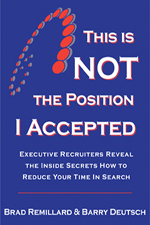
The first comment I get from candidates when I suggest these things is, “My resume will be too long.” No, it won’t. I have prepared thousands of resumes and I can get all of this on two pages. In fact, in our book, “This Is NOT The Position I Accepted” (CLICK HERE to review)  there is an example of a two page resume that contains all of this information. The person has over 20 years experience, so it is very doable.

Getting in the “A” pile is your responsibility, not the reader’s.

I wish more candidates would help us help them. All you have to do is give us the information we need to call you.

Contrary to what you may think, recruiters want to fill the position just as badly as you want the position.

For a FREE example of a cover letter CLICK HERE.

For a FREE example of a Thank You letter CLICK HERE.

For many more FREE resources and articles, join our Job Search Networking Group on LinkedIn. 4,300 people have done this. CLICK HERE to join.

I welcome your comments and thoughts.

Brad


5 Most Frequently Asked Job Search Questions I Receive

On Friday’s from 9 – 10 AM PDT we often conduct free “Candidate Open Forums.” These are conference calls open to all of our candidates, in which we discuss topics and answer questions directly from you – our candidates. Unfortunately, we are limited to 50 people on the line at one time, so often we can’t get to all of the questions submitted ahead of time via email.

We believe these are important, so from time to time in this blog we will discuss the topics and questions we, 1) don’t get to during the conference call, 2) are asked over and over again (so these are probably on your mind too), and 3) just consider important for you to know.

Remember, we are retained executive recruiters so the answers and thoughts come strictly from that perspective.

1) Chronological vs. functional resume? Easy answer – NEVER, NEVER, NEVER, use a functional resume. In my almost 30 years of recruiting I have never had any recruiter or hiring manager support the functional resume. I have also been on many panels where all of the panelists agree to NEVER use a functional resume. Functional resumes just scream out,”Try to figure out what I’m trying to hide.” See our free audio file on resumes.

2) How do we overcome negatives such as age, turnover, time between jobs, etc? We believe you address them head on. If you have a negative, avoiding it doesn’t make it go away. We have a blog entry “Preemptive Strike” which you should also consider reading. If you have a negative item, you should bring it up straight away, discuss it openly and then whatever happens, happens. Don’t assume, “They didn’t bring it up so it must not be a problem.” They didn’t bring it up because they already settled it in their mind. You need to preempt any preconceived ideas before they come into play.

3) What is the best method and frequency for following up on a resume? For us, as recruiters, we prefer via email or one of the social media forums, Linkedin or Twitter. Recruiters have reduced staff just like many other companies, while the number of calls from candidates has skyrocketed. It isn’t possible to call every person. Email allows us to reply late at night, on weekends, or even while waiting in the lobby of a client. I can’t do that with phone calls. Regarding frequency, if in fact you are dead on perfect, then after two weeks send a follow-up email.

4) With so many top level executives in the market, how do you differentiate yourself from the pack? This is the 64,000 dollar question. We believe the best answer is to have a very compelling resume which is targeted specifically to the position. A generic, one size fits all resume will not differentiate you. That is what “generic” means. In today’s market our clients and therefore recruiters, are seeking very specific backgrounds. We are not looking for the proverbial, “Jack of all trades,” we are looking for the, “King or Queen for a specific role.”

5) Is negotiating with the employer different today due to the economic situation, and if so how? There is a difference given today’s market. For example, most companies will not relocate today especially in a large market area. Also, companies tend to be closed to severance agreements. If you aren’t working, they figure there is no reason to give an agreement and they are in control. You have to pick your issues and know where to compromise. This is all part of the pre-planning process for a job search. What issues will you compromise on and which ones should you dig in your heels?

You can download a free 8 Point Job Search Plan Self-Assessment that will help you evaluate exactly what you need to do to improve your search. CLICK HERE to download.

Is your Linkedin Profile going to get you noticed. Our FREE Linkedin Profile Matrix will help you develop an outstanding profile. CLICK HERE to download yours.

Join our LINKEDIN Job Search Networking group. Over 4200 people have joined. CLICK HERE to join.

We realize not everyone will agree with these answers and that is healthy. So if you don’t agree, or wish to comment, we encourage you to do so. Just click the link below.

Brad Remillard

5 Tips How To Keep Your Resume Out Of The Black Hole

Candidates constantly complain about how when they email resumes they all seem to end up in the proverbial “black hole.”

As a recruiter, who receives on average 6 to 7 hundred resumes a week, I can understand your frustration. I’m also sure I may not be able to eliminate it, however, I hope I can help you reduce it with these few tips.

1) When you move from candidate to hiring manager remember your frustrations and treat the people sending you resumes as you want to be treated now. You know, the thing our parents always taught us about treating others the  way we want to be treated. Sounds so obvious but I just wrote another article about how rarely this happens.

2) The best way to avoid the black hole in the first place is not enter it. If you include a cover letter; a) don’t send it as a separate attachment to your resume. It should be the first page when the resume attachment is opened. b) use either Word or PDF to send your resume. I receive many resumes I can’t open. c) your cover letter should be designed to grab the reader’s attention. That means the cover letter must clearly and with a simple glance align your background with the needs of the job. CLICK HERE and download a free copy of a sample cover letter that does just that.

3) You don’t have to be the first resume received. Most ads run for at least 30 days. Many candidates have experienced most companies take their time. So wait a few days or even up to a week or more before replying. Avoid being one of the first 400 resumes. After the first blast of resumes come, as more trickle in one or two at a time, I will often just open the resume take a look at it and make a decision how to handle it. These people avoided the rush and got their resume reviewed.

4) First try the personal approach. With number 3 above in mind, use this time to try and find a personal connection within the company or recruiting firm. There are many ways to do this. 1) Linkedin should be first on your list. This is  exactly why you need to build your connections to the maximum number possible. 2) Google the person’s name, position, or company name, anything that will help you target the right person within the company. Then look for a personal introduction. Most recruiters value a referral.

5) Don’t use services that blast your resume to 10,000 recruiters and/or companies. This is a major waste of money. What do you expect will happen when someone receives a bunch of unsolicited resumes? What would you do with them? How do you handle unsolicited emails? Most call it SPAM. It doesn’t work.

Hope these tips are helpful and now your resume will at least pop to the top.

Designing a resume is the starting point of every job search. If your resume gets screened out it is worthless.

If you didn’t know these little tips our Complete Resume System is designed to make sure your resume gets noticed. We guarantee it. The hundreds of people who have used this system to build an effective resume are getting their resumes read. You can too. There are many more tips you should include in your resume. For more information about getting your resume noticed check out our Complete Resume System. CLICK HERE to view it.

You should join our LinkedIn IMPACT Hiring Solutions Job Search Networking Group. It is free on LinkedIn and there is an enormous amount of articles and discussions to help in your job search. That is why over 4000 people have joined so far. CLICK HERE to join if you are a LinkedIn member.

You can also download for FREE a sample cover letter to use that will align your background with those of the company. CLICK HERE to download your sample.

I welcome your thoughts and feedback.

Brad Remillard

Two Types Of Recruiters – Retained and Contingent

90% of recruiters fall into one of two categories, they are either retained or contingent. The difference is significant and a candidate should know the difference so that they know what to expect from each. Granted there are other types, but they are few and one rarely encounters them.

Since September of 1980 I have been an executive recruiter. I still run an executive search firm, IMPACT Hiring Solutions. For the first 13 or 14 years I was a contingent recruiter and since then have been a retained recruiter. Having worked both sides of the street, I will explain the difference and why it is so critical as a candidate that you know which type of recruiter you are working with so you can properly set your expectations. I hope this will reduce some of the frustration in dealing with recruiters.  I know it will not eliminate it.

As a starting definition:

1) Contingent recruiters get paid when the candidate starts working. Until then they are working for free. Think of them as a 100% commission sales person. No sale no income.

2) Retained recruiters get paid by progress in the search.  This payment stream varies by agreement between the company and recruiter, however, as a general rule it is the first third of the projected fee to begin the search, the second in some period of time usually 30 – 45 days, and the final third when the person starts or in some agreed upon time frame. The retained recruiter is guaranteed, if not all of the fee, at least two thirds regardless of whether a person is hired or not. Much like a lawyer or tax accountant, the fee is independent of the results.

One is no better than the other and both serve a purpose and market. Either type of recruiter can be professional and unfortunately unprofessional. There is no rule that guarantees that you will get a highly skilled and professional recruiter with either type, anymore than you can with a lawyer, accountant, counselor, or any other profession. There are good and bad in all professions.

So what should you expect from each of these and how does this differ in the real world and the day-to-day workings of each type of recruiter?

First some ground rules: 1) This is “Recruiters 101″ so I will not be able to cover every aspect and every situation. 2) This is an overview, so I will be discussing generalities. There are exceptions to everything. 3) Unless otherwise specified, I will be assuming a professional recruiter and not the flakes that are out there. 4) Don’t confuse recruiters with career counselors or coaches, resume writers or outplacement consultants. There is a big, big difference in all of these. 5) When possible I will try to contrast the two to help you understand what to expect from each.

Contingent Recruiters

Since they are basically 100% commission sales people, closing the sale is critical and so is time. When a company uses contingent recruiters, most of the time they engage more than one. Depending on the discipline and geographical area, that could be up to 10 recruiters working the same position. The company is also attempting to fill the position so the recruiter is not only competing against other recruiters but also the company.

Time is critical to contingent recruiters. The first recruiter to get the resume to the company is considered the recruiter of record and the one that will get the fee if that candidate is hired. Since candidates send their resume to multiple recruiters, having an inventory of candidates is critical. A good contingent recruiter wants active candidate’s resumes on file so that the minute a company calls with a job opening the recruiter can email resumes  before another contingent recruiter working with the same candidate can. This makes them the recruiter of record. From a candidate’s perspective, don’t send your resume to just any recruiter if you don’t want it sent out to companies without your knowledge. Contingent recruiters don’t want to take the time to call or email you, wait for a return call or email, to find that while they are waiting some other recruiter emailed your resume to the company.

Over screening resumes is the worst thing a contingent recruiter can do.

Contingent recruiters may or may not meet the company and hiring manager. This is not a requirement for contingent recruiters. Some will and some won’t. I always met every candidate before sending them out to a company. They may not have even been to the company, or ever met the hiring manager, so as a candidate you may not be able to expect all of your questions about the company, position, and future boss to be answered.

Retained Recruiters

Since retained recruiters get paid regardless of the outcome, they aren’t as driven by time as much as match. Retained recruiters generally have much longer guarantees so it is very important that the candidate is successful. For example, we have up to a year’s guarantee.

Retained recruiters are expected to be very selective. This is frustrating to candidates that think they are qualified, but the retained recruiter isn’t impressed. A big mistake candidates make is that they assume retained recruiters are looking for qualified candidates.  Retained recruiters aren’t looking for qualified candidates. The company can do that on their own. Retained recruiters are looking for exceptionally qualified candidates that the company can’t find.  As close to perfect as we can get.

Most retained recruiters have a very close working relationship with the company and hiring manager. They generally have spent a fair amount of time with the hiring manager, they should have a complete understanding of the position, and know what type of personality works well in this culture and with the hiring manager. Also, most retained recruiters will have an extensive screening process before the candidate moves on to meet the company.

A candidate should expect to be one of  4 or 5 candidates presented to the company for any one position.

The retained recruiter is not competing against other recruiters or the company. They know that if the candidate fails, this may be the last time they work with the company. Generally, they have a long relationship with the hiring manager and that is the person that hired them.

That is Recruiters 101, I welcome your thoughts and comments.

For more, join our LinkedIn Job Search Networking Group. CLICK HERE to join.

To learn more about the retained executive search process CLICK HERE.

If this was helpful to you then please pass it on to others. Consider emailing it to your network, updating it on your LinkedIn or Facecbook status, or mentioning it on Twitter. The more you help the better.

I welcome your comments and thoughts.

Brad Remillard

Job Hunters Searching For Help In Too Many Places

There are so many places to go today for help with your job search it is hard to know what is right, who is the best, what advice you should follow, and if you are doing things effectively. Everybody has a different opinion. Should you use Twitter, how much time to spend networking, do you need to change your resume, is your cover letter the best, what do to in an interview, etc.

What’s a candidate to do?

It really isn’t all that difficult to figure out. The answer is simple. It isn’t any different than other decisions you make, whether buying a home, buying a car, selecting a plumber or contractor, or what finance company to use.  You first decided what you needed (that was what YOU need), you then do your homework, seek out an expert in what you need, ask for referrals, if none are available you want to test drive the product or review their work, then  you decide.

Do the same in your job search. Filter out all the distractions. There are a lot of very good experts out there to help you. You just need to get the one that will work best with you and what you need in your search.

Some filtering ideas:

1) Identify exactly what you want or need help with. Don’t let some one else try to sell you on what they have to offer you. If your resume isn’t working, get an expert to help you with it, if you are getting interviews but not offers focus on that, if you are not familiar with using the Internet in your job search get help there, and if this is your first time looking in a long time you might need help with all aspects of your search.

2) Do your homework. Look around at what others are doing. Pick a book that has a reputable author. By reputable I don’t mean just because they wrote a book they are experts.  Review that authors background. Are they an expert in what you need? What makes them an expert? What accomplishments do they have similar to what you need? Ask for referrals. Read their book. Does it align with what you are seeing in the market and from other candidates?

3) Ask others for referrals. Who do they use to help them? If you don’t have a person to ask go on-line. In today’s world you can check out people and their credibility very easily. For example, if my partner Barry Deutsch or myself were referred to you or you simply wanted to check us out, all you have to do is Google our names. Look us up on Linkedin. There is adequate information out there on us and our firm for you to decide if we are credible and provide the services you need. It is the same for any expert in the job search business today. If that information isn’t available – run.

4) Can you test drive their services? Once you identify one or two people, due your due diligence. Can you test drive their products, can they provide examples of their services, can they produce a prototype for you, ask them for suggestions and decide if these make sense. Is the person responsive, have references, will they work with you as opposed to you working with them?

5) Then select the one or two experts you feel will best benefit you and work with them. Use them and abuse them. Forget about all the distractions out there. This is the best person for you and that is what works. If for some reason it doesn’t, then start the process again, just like you would with any other product or service. If you don’t like your banker, doctor, financial advisor, CPA, or the person doing your taxes, you move on and find someone else. Why should it be any different in a job search?

You should join our Linkedin Job Search Networking Group. It is free, has over 3300 members and an extensive amount of resources for you. CLICK HERE to join.

You can also get a FREE sample cover letter to help you. Over 2000 people have downloaded this. CLICK HERE to download yours.

Finally you can test drive our job search workbook to see if it is right for you. We will ship it to you for only $5. It is FREE for you to read and check out to see if it is right for you. We practice what we preach CLICK HERE to get yours. Readers have rated this book 4.5 stars out of 5.

Don’t Underestimate the Power the Four “A’s” Have On Your Interview

In a previous article, “Leveraging the Power of the First Impression Helps You Win the Interview” we discussed just how critical (not important, critical) the first impression is to the interviewing process. One of the suggestions was to understand the most important points known as the four “A’s.”

These four “A’s” can dramatically impact the interview before the interview even starts. That is powerful.

Each of these must be integrated into your interviewing style and come off as if they come naturally to you.

  • Appearance – This is not just how you dress for the interview, it is much more than that. It includes your body language during the interview, how you sit in the chair, the appearance of your resume and cover letter, the appearance of any materials used during the interview, eye contact, and I hate to say it, but it does include physical appearance.
  • Assertive – This is mostly about how you project yourself during the interview. Please take note, the word was not “aggressive.” There is a big difference between aggressive and assertive. Most interviewers respect an assertive person and dislike aggressive people. Do you come across as confident, do you answer the question with a strong voice, do you engage the interviewer during the interview, do you ask probing questions or just sit there and answer questions, do you mirror the interviewer, does your body language and voice have a strong presence?
  • Affable – Are you friendly, outgoing, easy to communicate with, engaging and even have a sense of humor? Does the interviewer feel comfortable talking with you, are they relaxed and feel at ease, do you have some conversational questions to bring up on the way from the lobby to the interviewing room, do you engage in casual conversation and are you building rapport with the person the second they lay eyes on you?
  • Articulate – How well do you communicate? Do you listen to the question? Are your answers sharp and succinct? Do you have proper language skills, syntax, avoid using the word “like”, proper sentence structure and use of verbs? Do you ramble in the interview to make sure you hit every point in your background or are you able to quickly get to the point? This can be one of the easiest of the “A’s” to master. It takes practice and rehearsing, and you will probably need a coach to help you with this one.

On the surface, as you read these, they seem so obvious. Most are thinking, “I already know this stuff.” This may be true, but I think the purpose of the four “A’s” is to highlight in a very simple way some of the key issues many candidates take for granted. As a result they don’t work on mastering them.

There are a lot of dynamics happening at the same time during the hiring process. The more you can master, the better your chances of getting the green light.

Join our Job Search Networking Linkedin Group. There are over 2700 members and an extensive supply of resources for you to tap into. CLICK HERE to join. Membership is FREE.

We have numerous free downloads on our Web site to help you in your search. Sample cover letters, audio downloads from past radio shows,a transferable skills list, Linkedin Profile Assessment Matrix, and our Job Search Self-Assessment Scorecard. All can be downloaded from our home page. www.impacthiringsolutions.com.

Every Monday at 11 AM PDT listen to our radio show from anywhere in the world on www.latalkradio.com channel 2.

I’m Perfect For The Position, So Why Did I Get Screened Out?

Great question. Probably an obvious answer.

The easy answer is, you probably aren’t perfect for the job, at least from the recruiter’s or hiring manager’s perspective. Now that doesn’t mean you aren’t perfect. It may mean you didn’t communicate effectively as to demonstrate just how perfect you are. So you get screened out.

It has been my experience in close to 30 years as a recruiter that candidates too often ignore the competition that also claim to be perfect for the job. As a recruiter in today’s economy, we can get 500+ responses to an executive level position, all claiming to be, “perfect.” With this volume of resumes, emails, phone calls and referrals, you have to demonstrate you are more perfect than all of the rest.

The real question is, “Have you demonstrated you are more perfect than all the others?” I realize candidates generally have limited information about the position, so demonstrating this can be difficult. It isn’t possible to give every screening detail. Anyone who has hired people knows this. Most hiring managers experience the same thing. When you are looking to hire some one you too get resume overload. So how do you prioritize all these resumes, calls, emails, and referrals? Most have set up some sort of checklist to reduce the number to a manageable figure. Some things on the checklist include, industry, company size, compatibility with products, systems, organization, title, turnover, etc. This is important information that is missing from many resumes. The result is you may get screen out or put in the infamous “B” pile.

The next step might be to further read the resumes that passed the checklist to reduce the number even further. It is at this stage that you must really demonstrate that you are perfect for the position. From a recruiter’s perspective this is the point where I want to see how your accomplishments align with what the client is looking for in the person they hire to deliver the results. This is the, “So why did I get screened out?” point.

Here are some suggestions that might help you to not get screened out if you really are perfect:

  1. Customize your resume as much as possible to directly align with the job. Don’t send the one-size fits all resume.
  2. Your bullet points must include quantifiable results, time frame to accomplish, and be believable.
  3. If you don’t know the exact expectations, some research on the company might give you some tips. If your research highlights issues, try to extrapolate how your functional area will participate in these issues and then how your accomplishments align.
  4. Don’t limit your research to the company’s Web site. Look for press releases, announcements, industry trends, local newspapers, business journals, industry periodicals, and Google the company and its competitors. It will take some work, however, the pay off is not getting screened out.
  5. Use a two column cover letter that compares your experience and accomplishments with what their needs are. (You can download a free sample cover letter on our Web site. (CLICK HERE to get yours)
  6. Keep your resume to two pages. Don’t have so much detail that the important points get lost.
  7. Make sure you have the basic screening information on your resume. Step back and be objective as to exactly how you screen resumes when you were a hiring manager with a stack of 300 resumes on your desk.

There are a lot of reasons you can get screened out, even if you are perfect. I’m convinced doing these few things will at least increase the odds in your favor. I’m sure they will increase the odds if you really are perfect for the position.

Join our Linkedin Job Search Networking Group for many more tips on helping you in your job search. CLICK HERE to join – it is free.

Our job search workbook deals with all of the issues one encounters in a job search. To review the book and have it sent to you for just $5 CLICK HERE. Readers rate this book 4.5 stars out of 5.

Three Most Important Words In a Job Search Radio Show

These three simple words have the biggest impact on your job search. They can make the difference between getting a job or not. That is the power they have. If you don’t know what these are then this is a MUST listen to. We not only give you the words but discuss how to ensure you implement them. Make sure you are the one that wins the interview and then the job. We are serious about the power of these on your job search.

Download the audio at http://www.impacthiringsolutions.com/index.php/candidates/free-resources/free-audio-programs

Download a sample cover letter the gets results at http://www.impacthiringsolutions.com/index.php/cover-letters

Join our LinkedIN Job Search Networking Group http://www.linkedin.com/groups?gid=1781587&trk=hb_side_g

What if Your Job Search takes 2X-3X longer than expected?

hourglass_sand_pouring_man_hg_wht

Amazing how time keeps marching forward in your job search like the sand through an hour glass. Every day, week, and month not spent conducting an effective job search drains your wallet and puts an unbearable level of pressure on your job hunting activities.

Miriam Salpeter, who writes a blog at Keppie Careers,  recently posted an article titled “What’s the Cost of Being Unemployed?”  Great article.  Miriam gave a few good examples:


If you expect a $20,000 salary, your weekly salary is $384.61 and an 18 week job hunt will cost you $6,992.98.

If you are looking for a job with a $50,000 salary, your weekly salary is $961.54 and an 18 week job hunt costs you $17,307.69.

If you are hoping for a $100,000 salary, your weekly salary is $1,923.08 and an 18 week job hunt costs you $34,615.38.


Many readers of our blog are in the $150K-$200K plus range. What’s the cost of your job search moving from a traditional 6 months out to 12-18 months?

Here’s the comment I wrote to Miriam’s Blog posting:


Excellent point about the cost of an extended job search. Most of the candidates I work with are significantly north of $150,000-$200,000 in annual income. Imagine the cost of a search that has gone from a traditional 6 months and is now approaching 12-18 months.

Here’s the irony: We provide many good products and services, like you and other gurus/experts in this field. Yet, my experience is that the vast majority of managerial and executive candidates would rather flounder around for 12-18 months at the cost of $150K-$200K instead of investing $29, $59, $99 in a proven validated product/service that will take months off their job search.

I realize folks who are out of work don’t want to spend money unnecessarily. However, like most things in life you’ve got to make a few key investments and spend a little money to make money. Most candidates we encounter have no clue what to do in an effective job search – and they’re trying the same strategies which may have worked 8 – 10 -15 years ago. Whether it’s our products/services, yours, another well-known expert – my recommendation would be for job seekers to become masters of the job search process. To do that requires purchasing audio, video, kits, courses, books, and workbooks. On top of all that great content is an extraordinary amount of FREE resources which few people take advantage of.

I just wrote a recent article on my blog about mastering the job search. My partner Brad and I will be discussing this idea in our weekly radio show on Monday.

Barry

P.S.: On Monday in our Radio Show we will release our long awaited Self-Assessment Scorecard to determine if your Job Search Plan is adequate to complete a quick and effective job search.