Posts tagged: Interviewing

Answering Those Box Checking Interviewing Questions – Audio Recording

Don’t Be A Box-checking Victim

STOP allowing yourself to be box-checked in the interview by recruiters, HR, and hiring managers. You CANNOT SUCCEED in the interview if you are being box-checked against a traditional job description listing precise years of experience, exact industry experience, product knowledge, specific channels, and detailed skills. No one could pass these interviews with flying colors. Successful interviewing requires you to move the interview from a typical interrogation into a conversation about the needs and obstacles in the job. Brad and Barry provide specific examples, tactics, and recommendations in this radio program on how to move every interview from a box-checking interrogation into a conversation about the work that needs to be done.

To listen or download this recording from our audio library CLICK HERE.

You can also join our LinkedIN Job Search Networking Group. CLICK HERE to join


5 Most Frequently Asked Job Search Questions I Receive

On Friday’s from 9 – 10 AM PDT we often conduct free “Candidate Open Forums.” These are conference calls open to all of our candidates, in which we discuss topics and answer questions directly from you – our candidates. Unfortunately, we are limited to 50 people on the line at one time, so often we can’t get to all of the questions submitted ahead of time via email.

We believe these are important, so from time to time in this blog we will discuss the topics and questions we, 1) don’t get to during the conference call, 2) are asked over and over again (so these are probably on your mind too), and 3) just consider important for you to know.

Remember, we are retained executive recruiters so the answers and thoughts come strictly from that perspective.

1) Chronological vs. functional resume? Easy answer – NEVER, NEVER, NEVER, use a functional resume. In my almost 30 years of recruiting I have never had any recruiter or hiring manager support the functional resume. I have also been on many panels where all of the panelists agree to NEVER use a functional resume. Functional resumes just scream out,”Try to figure out what I’m trying to hide.” See our free audio file on resumes.

2) How do we overcome negatives such as age, turnover, time between jobs, etc? We believe you address them head on. If you have a negative, avoiding it doesn’t make it go away. We have a blog entry “Preemptive Strike” which you should also consider reading. If you have a negative item, you should bring it up straight away, discuss it openly and then whatever happens, happens. Don’t assume, “They didn’t bring it up so it must not be a problem.” They didn’t bring it up because they already settled it in their mind. You need to preempt any preconceived ideas before they come into play.

3) What is the best method and frequency for following up on a resume? For us, as recruiters, we prefer via email or one of the social media forums, Linkedin or Twitter. Recruiters have reduced staff just like many other companies, while the number of calls from candidates has skyrocketed. It isn’t possible to call every person. Email allows us to reply late at night, on weekends, or even while waiting in the lobby of a client. I can’t do that with phone calls. Regarding frequency, if in fact you are dead on perfect, then after two weeks send a follow-up email.

4) With so many top level executives in the market, how do you differentiate yourself from the pack? This is the 64,000 dollar question. We believe the best answer is to have a very compelling resume which is targeted specifically to the position. A generic, one size fits all resume will not differentiate you. That is what “generic” means. In today’s market our clients and therefore recruiters, are seeking very specific backgrounds. We are not looking for the proverbial, “Jack of all trades,” we are looking for the, “King or Queen for a specific role.”

5) Is negotiating with the employer different today due to the economic situation, and if so how? There is a difference given today’s market. For example, most companies will not relocate today especially in a large market area. Also, companies tend to be closed to severance agreements. If you aren’t working, they figure there is no reason to give an agreement and they are in control. You have to pick your issues and know where to compromise. This is all part of the pre-planning process for a job search. What issues will you compromise on and which ones should you dig in your heels?

You can download a free 8 Point Job Search Plan Self-Assessment that will help you evaluate exactly what you need to do to improve your search. CLICK HERE to download.

Is your Linkedin Profile going to get you noticed. Our FREE Linkedin Profile Matrix will help you develop an outstanding profile. CLICK HERE to download yours.

Join our LINKEDIN Job Search Networking group. Over 4200 people have joined. CLICK HERE to join.

We realize not everyone will agree with these answers and that is healthy. So if you don’t agree, or wish to comment, we encourage you to do so. Just click the link below.

Brad Remillard

Never Waste A Thank You Letter Saying Thank You

After an interview, sending a “Thank You” letter is common etiquette and a nice thing to do, but saying “thank you” should not be the main reason for sending it. Most candidates send one after interviewing with a company, but as a recruiter, I rarely receive one. I personally don’t need one, but on the occasions when I have received one, I think the candidate misses a great opportunity by just saying, “Thank you for the interview.”

I believe a good “Thank You” letter should be used to reinforce your ability to do the job and/or address any potential issues that came up during the interview. It can be another marketing document. It is important not to over do it, but a tactful letter, that does some subtle marketing can have a big impact on the person reading it.

For example, a few years ago a candidate called me after an interview and said, “I think I blew the interview.” The CEO asked me, ‘What my career plan is for taking this position?’ I answered how over the next few years I would impact my department and how that would impact the company. The CEO responded, “That is fine, but we really want people that want to grow and maybe some day have my job.” The candidate asked me what would be the best way to recover from this or if there was a way to recover. The answer was the, “Thank You” letter.

A carefully worded, “Thank You” letter explained to the CEO that the candidate interpreted the question as asking for the short term impact he would have once on board. He went on to explain, in the “Thank You” letter, that certainly in the long-term his desire was definitely to advance, but he realized that was dependent upon him doing an exceptional job in the role he was being hired to fill, hence the reason for answering the question as he did.

The candidate had the opportunity to address a miscommunication during the interview, which is a common problem with interviews. Ultimately, the candidate did get the job. Would he have gotten it anyway? Hard to tell. One thing is certain, the candidate didn’t think he would have.

Some other basic issues regarding a “Thank You” letter:

  • One page maximum
  • Send shortly after the interview
  • Not an email (with the possible exception of IT professionals)
  • Addressed to a specific person, not “Dear Interviewer” or salutation left blank
  • Individualized to the particular interview, personalized to the specific topic
  • Do not use a generic one-size-fits-all thank you letter

Consider using this as one more chance to market yourself. Don’t over do it. This is not the time for a hard sell. It must be subtle and tactful. It won’t work all the time, but hopefully as in the example, it will work the one time you really need it.

Download a FREE sample Thank You letter along with some Do’s and Don’ts for Thank You letters. CLICK HERE to get yours.

Join the IMPACT Hiring Solutions Job Search Networking group.  There are over 4000 members . JOIN BY CLICKING HERE.

We encourage comments and your feedback.

Brad Remillard

2 Simple Questions I Asked 10 Job Seekers And They Failed

This is why recruiters and hiring managers get frustrated with candidates. For the most part this demonstrates why most candidates fail the interview. Candidates leave an interview thinking all went well, when in fact, the candidate is not going to be asked to come back.

It also demonstrates why candidates need to consider investing in their job search. There are many great resources available to ensure candidates conduct a really effective and professional job search. In today’s economy a job seeker can’t afford (literally) to be anything less than 100% effective.  Unfortunately, none of these 10 will get the job. If they had invested less than $100, I believe they could have properly answered these simple questions.

Instead they will spend more time looking, ultimately costing them thousands of dollars. Who knows when another opportunity will come up.

So here are the two simple questions I asked the senior executives.

1) Do you consider yourself to be a person who demonstrates high initiative on a regular basis? All 10 basically answered, “Absolutely.” Not just “yes”  but “absolutely.”

The obvious follow-up question to me is:

2) Can  you give me a specific example  where you demonstrated high initiative in your current or most recent role? This is where the interview collapsed. Not one could give me an example of high initiative. All 10 either  rambled on and on hoping I would forget the question or the example was what I would normally expect them to be doing as part of their job. Not HIGH initiative.  Not one could provide an example of something they claim to do on a regular basis.

Basically they were not prepared. They all answered positively expecting that to be the end of it.

If they claim to “absolutely” demonstrate high initiative on a regular basis, I would expect them to have at least one example. That doesn’t seem like a trick question to me.

Why these candidates were not able to answer this simple question is beyond me. I can only think, like many candidates, they thought, “I will just wing it.” Proper preparation isn’t all that important.  The key word is, “proper.” They may have prepared, but obviously not the right or effective way.

I wonder how many times a day a candidate blows the interview or a candidate’s resume gets screened out for something simple.  How many candidates are still searching only because they refused to invest  in their job search. In the same way,  many people  invest in anything they want to become proficient at, including piano lessons, golf lessons, tennis lessons, lessons to learn a software program, etc. investing in a job search is just as critical. I believe  a lot more critical.

Every extra day in a job search is costing these people thousands.

So what can you do  so it doesn’t happen to you:

1) The internet offers an endless amount of free resources for all to tap into.

2) Not all resources are right for every person. Some may be more appropriate for technical people, some for non-professionals or for professionals, and some are primarily focused at managers and above. Search until you find a resource that fits  your needs. Like most things job search resources are not one-size-fits-all.

3) Once you find a resource take full advantage of the free offerings. Read the blog articles, listen to any audio files, if the offer free webinars attend them. Use these free resources to the fullest extent you can.

4) Only after you trust them and recognize they are right for you, don’t be afraid to invest a few bucks. Nobody can possibly give away everything for free. They  have to make a living too.  Since you have already engaged them and trust them purchasing a book, CD,or  attending a paid webinar will be worth every penny. Many won’t even charge you until  you are completely satisfied or offer a money back guarantee. That takes away any risk of wasting money.

5) Seek their help with your resume or interviewing skills. Many will give you a first pass for free. Again, if you trust them investing a few bucks may make the difference between getting a job and not getting a job. I know it would have helped these ten people.

The best thing you can do for your job search is to make sure you don’t lose an opportunity because of a simple mistake. In this economy it may be a while before another opportunity comes along.

To practice what we preach, we offer an enormous amount of free resources for you to take full advantage of.  I encourage you to use these resources as often as you like and to their fullest extent. For example:

1) Our extensive audio library recordings from our weekly radio program on www. latalkradio.com CLICK HERE to review the program listing.

2) Our FREE sample cover letter. Over 2000 people have downloaded this. CLICK HERE to download yours.

3) Our FREE Linkedin profile assessment. Build a great profile on Linkedin. CLICK HERE to download yours.

4) Over 4000 people have joined our Linkedin Job Search Networking Group. CLICK HERE to join.

5) Download a free chapter from our job search  book on phone interviewing tips. CLICK HERE to download.

6) These are just a few of the free offerings on our website. There are many more for you to take advantage of without buying anything.

FULL DISCLOSURE. Yes, there are products to buy on these pages. If this is your first time you should check out the free stuff first. If those are helpful and you still need help then you can check out the products. We offer most of them on a free trial basis. You don’t have to buy anything until you are sure it will help you.

We want to be a resource for  you in your job search. Our goal is the same as yours. We want to help you spend as little time in a job search as possible.

I welcome your thoughts and comments.

Brad Remillard

Job Seekers Should Stop Being So Hypocritical

For 30 years this September, as both a contingent and retained recruiter, I have listened to the complaints by candidates (job seekers) about hiring managers and the complaints by hiring managers about candidates.

Even after 30 years, as I read blog comments, or sit in a chair and listen to these complaints, I’m still amazed (yes, amazed) at the hypocrisy spewing out from both candidates and hiring managers.

I read the comments to our blogs where candidates complain about the black hole when they send resumes, they complain about how long it takes to fill a position, they complain about recruiters, they complain about not getting their calls returned, they complain that their resume doesn’t get read in great detail, they hate the 10 second resume screen, they complain about cover letters, they complain about how these hiring managers are missing qualified people, they complain that the interview wasn’t fair or too short or too long, and that the person conducting the phone interview wasn’t qualified and didn’t know the job. This list could fill a book about the size of War and Peace, or for those not into War and Peace, book seven of Harry Potter.

Sound at all familiar if you are seeking a new position?

I then listen to hiring managers, HR, CEOs and key executives who are doing the hiring complain that, I get too many resumes, I get tired of interviewing average candidates, I will get to those resumes this weekend or next weekend, the resumes don’t match my job, candidates don’t know how to interview, candidates can’t put together two complex sentences, they complain that recruiters aren’t screening tight enough, they complain recruiters are screening too tight, they get angry at the recruiter for wasting their time interviewing unqualified candidates, they rule a qualified candidate out because they didn’t like the way they sat in the chair (I’m not kidding), they rule a candidate out because his tie was not straight (No, I’m not kidding), give me a job spec so tight and narrow that they themselves (this person’s boss and direct report) wouldn’t be qualified, tell me that from a 15-minute interview this person won’t fit, isn’t assertive enough, or my favorite, the candidate isn’t a  team player (so I ask, “What teams will they serve on?” Answer, “Well not right away, but probably in the next two years.”) They also don’t like the candidate’s handshake, or for this sales position the person needs to be a real go-getter, outgoing and aggressive (so then I ask if they like being approached by outgoing, aggressive sales people and they reply, “No, of course not.”) I could fill another book the size of War and Peace with these complaints.

Then I realized in both cases,  I’m talking with or listening to the exact same person.

Job seekers become hiring managers and hiring managers become job seekers.

The problem is that when they move from one side of the desk to the other, their perspective changes, their needs change, their priorities change, and it is a whole new ball game. Hiring, whether it’s a candidate or hiring authority is “all about me” and “what’s in it for me?”  That is just the way it is. Right or wrong, good or bad, like it or not, that is the fact of hiring.

So the next time, before you complain, from either side of the desk, please take a step back, look at yourself and treat the person on the other side of the desk with the same respect you complain about.

I know, I for one, would surely appreciate it.

You can download many free tools from our Web site. Our most popular free resource is the sample cover letter. CLICK HERE to get one.

If your LinkedIn profile is just fair to average download our free LinkedIn profile assessment to help you build a great profile that gets you noticed. CLICK HERE to download.

You should also join our LinkedIn Job Search Networking group. This group had 3,900 members. The articles and discussions can only help you with your job search. CLICK HERE to join, all are welcome, and of course it is free.

I welcome your thoughts and comments. Good or bad, agree or disagree, all voices are welcome. Just be respectful.

Brad Remillard

3 Simple Absolute Musts In A Job Interview

Interviewing is an art more than a science. Like most art, there are the Van Gogh’s and then there are those that work hard but never reach a professional level. They may still be good, just not good enough.

I think that is the way most candidates approach the interviewing process. They think they are good, when in fact, most are not good enough. This is especially evident when a candidates tells me, “I’m getting interviews but just not getting the job.”  To me, that rings out loud and clear, you need to take a look at your interviewing skills.

Here are three things I find missing with candidates in an interview.

1) Confidence I find this lacking, especially with candidates that have been in a job search for a long time. As they become more and more desperate they tend to exude less and less confidence. This comes across in a number of ways that I believe most candidates don’t even realize. For example, body language,  how you sit in the chair, eye contact, tone of voice, confidence in answering questions, staying so general in the answer for fear that getting too specific or detailed may rule you out, or giving long rambling answers so as to encompass everything in the hope that you have covered what they are looking for.

Nobody wants to hire a person that isn’t confident. This is especially true at the manager level and up. Few want someone that comes across so weak they will not voice an opinion.

With candidates I coach, I always recommend  interviewing the same way you would if you had a great job and didn’t need the one you are interviewing for. I believe this helps in bringing out the real you. Most candidates act differently on the job than in an interview, so it is very important that the interviewer sees you as you would be on the job.

2) Questions In many ways this is a symptom of confidence. Why is it when an interviewer asks, “Do you have any questions for me?” candidates often say, “No not right now.” I don’t understand that.  This clearly demonstrates weakness, lack of interest, or lack of understanding of the position, any of which gets one knocked out of the running.

This is your opportunity to shine, to demonstrate your depth of understanding, to probe, to engage, get clarification, and basically stand out. I think one of two things stops candidates from asking questions; 1) fear that they may appear to be too confrontational or challenging or 2) lack of preparation. Either one is generally not going to help the candidate win the interview.

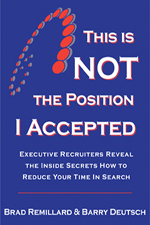
All candidates should be well prepared with questions. There are so many areas that  you can ask good questions about that will help separate you from all of those that don’t. This is so important that in our candidate job search workbook  “This Is NOT The Position I Accepted” we have over 135 questions to ask in over seven different categories. That demonstrates the importance of asking questions in the interview.

3) Preparation This is probably the solution to the first two.  Taking the time to properly prepare is the biggest problem I have discovered over and over again that candidates fail to do or do properly. Poor preparation is just as bad as no preparation. Here are some stats I have been keeping as I have asked candidates about their preparation.

A) Less than 5% of candidates have actually written out answers to the most basic questions that they know will be asked in an interview.

B) Less than 1% have actually video recorded themselves interviewing.

C) Less than 1% have conducted mock interviews.

D) Less than 10% prepared questions they wanted to ask during an interview.

E) Less than 20% have asked others for feedback after an interview that they didn’t get.

F) Less than 10% have identified any weaknesses in their interviewing style.

G) Less than 2% know all of the three things that can be measured during a phone interview.

H) Less than 10% can give very detailed answers about the bullet points on their resume.

I) Less than 1% have even considered body language in preparing for an interview.

J) Less than 5% prepare for an interview the right way.

K) Less than 50% know they have a weak handshake or poor eye contact.

Not everyone makes all of these, but to my surprise most make many of them. This is why candidates are often not good enough at interviewing.

You can get our Candidate Job Search Workbook for FREE (just pay $5 shipping). You can review the questions, read the multiple chapters on interviewing, and even learn the ten must ask questions in an interview. CLICK HERE to learn how to get your workbook sent to you for just the cost of shipping.

Download our sample cover letter. This will help make sure your resume aligns with the position, and recruiters appreciate this style. It is free.  CLICK HERE to get yours.

Finally our LinkedIn Job Search Networking Group is free to join and all are welcome. This group has over 3,800 members and a wealth of articles, job postings and discussions to help you. CLICK HERE to join the group.

I welcome your thoughts and comments.

Brad Remillard

An Absolute Must For A Job Interview

One of only three things that can be measured during a phone interview is communication.  The interviewer is determining how well you communicate and how well you will work with the management team. Communication style is critical to cultural fit. If you are thinking verbal communication, in this instance you are half right. Most candidates think we are talking about one’s use of the English language and proper use of verbs, avoiding the word “like,” being succinct, and all the other verbal components of communication. Generally you are correct, but not this time.

This time I’m referring to listening skills. This is also a component of communication. Before you click away, recognize that study after study revealed that most people are not good listeners. In the case of candidates not being good listeners, this happens not necessarily because you are not generally a good listener, but rather because of the interviewing process itself.

Too often candidates don’t hear the complete question because mid-question they start thinking of an answer to the question that hasn’t even been asked yet. The candidate anticipates what they think the interviewer is going to ask and then starts formulating an answer in their mind. Too often to the wrong question.

I have interviewed over 10,000 people in my 30 years as a recruiter, and this is a constant battle. This is even more profound on a phone interview. I believe it’s due to the fact that the candidate can’t see the interviewer, and can’t tell by body language or eye contact when the end of the question is coming is one reason why it is such a problem on a phone interview.

Failure to listen to the complete question and then targeting the answer to actual question is one reason why so many qualified people never get the job. I hear this from hiring managers all the time.

Most candidates will be better off taking a slower approach and listening carefully prior to jumping in with an answer that isn’t relevant to the question.

Work on your listening skills. Don’t just assume you have good listening skills in an interviewing situation. This is a unique environment. You may be a great listener day to day, but when the pressure of an interview and your desire to do a great job collide during the interview, listening is usually the first thing to go.

If this was helpful to you please help others by passing it on. Everyone needs to help everyone until the economy turns. Consider emailing it to your network, posting on a blog, adding to your status on Linkedin or Facebook or Tweet it. Let’s help others. It will come back to you.

Join our Linkedin Job Search Networking Group for a lot more discussions and articles to help you with your job search. CLICK HERE to join in.

Download our FREE 8 Point Job Search Self-Assessment Scorecard. Identify the strengths and weaknesses of your job search so you jump start your search in 2010. CLICK HERE to get your free copy.

You can also download a free sample cover letter that  has proven to align your background with what the company needs. Thousands already have and it really works. CLICK HERE to get yours.

I welcome your comments and thoughts.
Brad Remillard


10 Simple Job Interviewing Questions Most Can’t Answer

I was sitting in on an interview with one of my clients recently, when out of nowhere came a question that not only made the candidate take pause, but also probably eliminated him for the job. It wasn’t a trick question or illegal question. It wasn’t a question that the candidate couldn’t answer. In fact, it was so simple the candidate should have been able to answer it easily. Instead, he sat there like a deer in the headlights thinking, because he didn’t have an answer. The mere fact that he had to think on such a simple question was a problem to begin with.

So what was this simple question, “What is the most recent book you have read that will help you be a better employee?” This could be any business related book on,  leadership, management, social networking, staffing, biographical,  functional, organizational, self-improvement, etc in the last 6 months. The person has been unemployed for 3 months so it isn’t  unreasonable to assume they read, or is it?

So what would you have replied? Please leave your answer in the comments section.

I find it amazing how many professional people don’t read on a continuing basis. If for no other reason than to stay up to date on trends, changes and advancements in their field. So many candidates stop reading non-fiction after college. We find that the very best candidates we work with are continually improving themselves by reading. Not just periodicals like the WSJ, trade magazines, or blogs, but books.

I started thinking back about other similar questions I’ve heard asked, usually by CEO’s, during an interview that most can’t answer. I’ve listed them below to help you out, so you don’t end up looking like a deer caught in the headlights.

1. What do you do to stay current and up to date in your profession?

2. How many workshops, seminars or training programs have  you attended in the last year?

3. What is your favorite book on leadership?

4. What book has impacted how you manage or lead the most?

5. If  you could only refer one book to someone coming up the ladder what would it be?

6. What do you do regularly to improve yourself?

7. In your annual reviews, what has your boss recommended you need to work on or improve on? After they answer, the follow-up is, What have you done to work on those issues?

8. How many books have you read in the last year?

9. What periodicals do you read daily or weekly?

10. What is your favorite business book of  all time?

I have heard all of these asked in one form or another in my 30 years as a recruiter. In fact, I even ask them when I know a client will ask them.

The fact that these questions may not directly link to one’s ability to perform in the job, they do reveal a lot about the person and their understanding to constantly improve themselves. A CEO that wants to constantly improve the company wonders how a candidate can do this, if they don’t even work to improve themselves.

I hope this helps you better prepare not only yourself, but for an interview.

Join our Linkedin Job Search Networking Group. 3400 others have joined in on the discussions and articles. CLICK HERE to join.

Download our FREE sample cover letter. This is a proven cover letter that gets your resume noticed. CLICK HERE to download.

Have you browsed our FREE audio library?  All of the recordings from our talk radio show are there for you to download and listen to for free. CLICK HERE to download.

I welcome your thoughts and comments.

Brad Remillard

I’m Getting Interviews But No Offers. WHY?

This was a question a potential job search coaching candidate asked me. Although frustrating, at the same time it is a very good problem to have. At least she was getting interviews.

In today’s world just getting up to bat can be difficult, but striking out is frustrating. So what do you do if this is happening to you? Over 30 years of working with candidates and over 10,000 interviews, it is my experience that when this happens the candidate is generally making some fatal mistakes in the interviewing process. They don’t need a major overhaul. They are either doing something small, that is easy to fix, or in most cases NOT doing something that eliminates them.

After all, the hiring manager has seen their resume, often interviewed them and asked them back, and they may have even come in second place a couple of times.  So rarely, if this happens a lot, is it always experiences, skills or abilities. Those have already been taken into account. Also, as everyone knows that has done extensive  hiring, the most qualified person doesn’t always get the job. Often, and unfortunately, it is the best interviewer that gets the job. A fact candidates have a very hard time accepting.

Many candidates have this  happening to them and never really understand, “why?” The sad part is the candidate ends up spending a lot more time in job search mode than necessary. Often months and that is expensive. To help, our job search workbook, “This is NOT the Position I Accepted” deals extensively with this exact issue.

The first step in dealing with this issue is knowing the answer to this critical (yes critical) question, because if you don’t know the answer chances are very good you will never know what’s wrong, so you can’t fix it. What are the most important three words in a job search and interview? Hint, they are the same words for both a job search and interview.

If you guessed preparation, good guess, but wrong. Preparation is the outcome of these three words.

Presentation is key, and the answer. Candidates are judged so much on the their presentation that it is often a bigger factor in getting a job than qualifications. For example, I heard on a news channel that Whole Foods will not hire anyone that shows up to an interview wearing a suit. I don’t know if this is true or not, (just because it was on the news doesn’t make it true) but that is presentation. Show up in a suit, and before you even leave the lobby, before you introduce yourself, in less than 1 second the hiring manager has already decided you won’t fit in their company’s culture. They assume you didn’t research the company or you would know this.

If this is happening to you, I have found from coaching candidates that it is time to take a hard look at their presentation. This is very hard to do. It means I have to be tough, possibly risk hurting feelings, get critical, tell people they come across too casual and therefore possibly signaling a lack of energy, and for older candidates this is often interpreted as burned out or just waiting to retire.

None of these may be true. It doesn’t matter if it is true or not. It is reality. A dose of reality is often exactly what many candidates encountering this issue need.

Another issue is confidence. Too often when candidates become desperate and really need a job they are too afraid to engage the interviewer. This lack of confidence comes across as weakness. This is the kiss of death especially if you are interviewing for a manager.

You should always interview the same way you would if you had a great job and didn’t need this job. That confidence will come out. Most companies want to hire people that are leaders, and confidence is an essential element of leadership.

Join our Linkedin Job Search Networking Group along with the other 3300+ members. The discussions and articles will do nothing but make your time looking for a job shorter. CLICK HERE to join.

If you are getting interviews but no offers, you should consider reading our job search workbook, This Is NOT The Position I Accepted. It was written to get you through the interview with confidence. We will send it to you to review for just$5. CLICK HERE to get  your copy.

I welcome and encourage your thoughts and comments.

Brad Remillard

Are You Speaking the Right Language During the Interview?

Candidates too often focus exclusively on the verbal communication aspects of a job search. How much time have you spent on the body language aspect of communications?

Some say body language is 70% of communications. Whether or not you agree with this  percentage is irrelevant. All will agree it is a high percentage. So that begs the question, “What have you done to ensure your body language is communicating the right way?”

Knowing I was going to write an article on this topic, for the last two weeks I have asked over 100 candidates, “What have you done to ensure you are using proper body language during your job search?”  Not surprisingly, most just looked at me like a deer in the  headlights.  A few actually knew what I meant and one even admitted they had thought about it. The famous thought about it, not necessarily done anything about it. Two indicated the outplacement firm had videoed them so they could see themselves.

Given this incredibly high percentage, I would think more candidates would at least have read up on the subject, maybe videoed themselves in a mock interview, or practiced so as to be aware of what to do and not to do.

The reason for this topic is because of feedback I received from an interview one of my candidates recently had. The problem wasn’t regarding the person’s technical abilities, it was around the candidate’s body language and what it conveyed. Right or wrong, it doesn’t matter. In this economy the company can move on to the next candidate, get the same technical abilities and body language that conveys the right message.

When I met with the candidate, I noticed a couple of issues and mentioned them to the candidate. One was poor eye contact and the other was how he sits in the chair. He looked at me when the question was being asked, however, as he started to answer the question he would lose eye contact. He would look down, glance up from time to time then look back down, adjust his glasses, and then look down. I mentioned this to him. At first he was shocked, denied it, and flat out didn’t believe me. I have mentioned this hundreds of times to candidates over the last 30 years. This is a common reaction by most candidates. They don’t even realize they are doing this. Nobody has ever told them, and since they have never been videoed, they can’t see it for themselves.

The second thing I mentioned was how he sits in the chair. He was rather tall so he tended to slouch down in the chair almost like one does at home on the couch while watching a baseball game. I strongly recommended sitting up straight, and when wanting to stress a point, he could even slightly lean forward to engage the interviewer. Coming across overly relaxed in a somewhat formal setting of an interview is not the proper presentation. As my client said, “This would not look appropriate during a board or investor meeting.”

As a candidate, you should not assume you have good body language. You should test it. Consider videoing yourself. You will not only notice  poor body language,  but you will also pick up little nuances that you don’t even realize you are doing. This is a powerful tool. Most candidates have or can  borrow a video camera to work through this exercise.

Don’t underestimate body language. It not only applies during an interview, but also in your networking. People only want to refer others they are proud of. If you present poor body language in a one-on-one networking coffee you probably will not receive any referrals.

Our Linkedin Job Search Networking Group has over 3000 members and provides a wealth of topics and resources for you. CLICK HERE to join, it is FREE.

Also, our Web site has a sample cover letter for you to use that will help you stand out and align  your background with the job needs. You can find it at the bottom of our home page at  www.impacthiringsolutions.com in the “What’s New” section.

I welcome your thoughts and comments. If  you have a story about poor body language, please share it so others can learn.

Brad Remillard