Category: Resume

How To Get Recruiters To Reply To Your Resume

I know this is one of the major complaints by candidates. I hear it all the time, “I send them my resume and they don’t reply. Most won’t even return my phone call.”  As difficult as it is to say, for the most part these candidates are correct. That doesn’t mean it is right, it just means you are correct.

Similar to most at the manager level and above, when you are working, you are generally overwhelmed with things to do. So you have to prioritize. Some things are high priority and some things go on the low priority list. The low priority items may never get done, or may get done in the next few months. Generally, this depends on what other higher priority items trickle in.

Recruiters are really no different. We have to prioritize our day. Some things are high priority and other things are low priority. If  you want to engage recruiters, your job when working with or contacting them should be to move up the priority list. Knowing how I, and many other recruiters prioritize, might help you do this.

Here is how I set priorities regarding the basic duties as a retained recruiter.  Contingent recruiters might vary slightly, but when I was a contingent recruiter it wasn’t a whole lot different.

High priority:

  1. Clients always come first. So some might ask, “Who is your client?” The company paying my fee is the client, not the candidate. Therefore, the company has first priority on my time. That means I will return their phone calls before a candidate’s, I will meet with them prior to a candidate, reply to their emails first,  and screen resumes they send me first.
  2. Candidates on an active search. These are candidates that I’m actively working with on an existing retained search. They could be at any stage within that search which includes, recruiting ones I have identified, interviewing them, returning their calls or emails, reviewing their resume, meeting them, scheduling interviews, following up after an interview, compensation discussions, reference checking, or basically anything I need to do to move the candidate and the search to the next phase.
  3. Marketing. The next priority for me is marketing. This is meeting with clients and potential clients, attending networking meetings, and making sure I’m out in the market so that when a search comes up I’m the one that gets the call. When that call comes, refer to number 1 above.

Important but not a high priority. These I try to get to by the end of each day. Sometimes they spill over to the next day, but I usually try to complete these within 24 hours.

  1. Returning emails not related to a search from people I know or have worked with in the past. These are generally people updating me on their search, prior clients with a question, a request unrelated to an active search, general emails, and clearing SPAM. Sometimes I don’t get to these until the afternoon. I scan down the “sent from” and subject lines, and when I see someone I know I will read the email and then reply appropriately.
  2. Reply to emails and return calls that are a referral. If someone is referring a person to me, I will always reply. I respect the fact that they have taken the time to do this. I feel I owe the reply out of respect to the referring source.
  3. Return voice mail calls. Basically the same as above. I listen to them and clients get an immediate call. Anything to do with an active search gets a call. Others I evaluate and make a decision on what to do with them. Refer to low priority below for many, not all, of these calls.

Low Priority:

  1. Return emails from those I don’t know. This is one of those low priorities that tick many candidates off. The good news is that you have a much higher chance of getting a return email than a phone call. I often try to catch up on these on the weekend or at night. Because of the large volume of these, I’m often two weeks behind.
    1. If you are just sending me an unsolicited resume, I may or may not reply to you. Generally not. I may take a look at the resume to see if it fits an active search. Probably less than 50% of the time I reply. This is why I preach, tweet, and blog,  DON’T WASTE YOUR MONEY ON A RESUME SERVICE THAT WILL SEND YOUR RESUME TO 1,200 RECRUITERS. Save your money as most recruiters don’t even look at them. I doubt more than 5% of retained recruiters do.
    2. If the email is just to introduce yourself to me with no referral,  I will probably just delete it. What else can I say? Like me or hate me, that is what will happen. (If it makes you feel better, then “yes” I spend hours late at night reading the hundreds of unsolicited resumes I receive on a weekly basis).

Lowest priority. So low that I have to be bored and/or very lonely to take action. I’m desperate to just talk to someone and my wife and kids are all busy. I have probably already called every person in my contact list, any tech support that I can possibly think of, and if it’s the only way to get out of having to watch Driving Miss Daisy or The English Patient, I will claim I have to return these phone calls.

  1. These are the  voice mails that simply say, “Hi Brad, this is (fill in the blank) please call me at (fill in the number. I probably don’t even recognize the area code).” or “Hi Brad, this is (fill in the blank) I just want to introduce myself to you. Please call me at (fill in the blank).”  I will apologize now to all of those I have offended. Sorry, if I didn’t return your call.  It is just that I don’t have the time, and I rarely can help you.  I know each call is going to take 5–10 minutes, and in the end, I can’t do anything for you. I used to make a list of these calls. When time permitted, I would work my way down the list but over time the list just got too big. For every 3 calls I returned, I added 5 or 6. I stopped adding to the list when it exceeded 100 calls to return. Sorry, but this many calls to return just isn’t possible. Heck, it is hard enough to reply to that many emails.

It isn’t personal, and please don’t take it personally, when recruiters don’t get back to you. Most recruiters are not trying to be rude, but as I said in the first paragraph, we only have so many hours, just like everyone else, and we have to manage our time too.

My guess is that most managers, when working, don’t have time to return calls from all of the sales people that call. My guess is that you also don’t return unsolicited calls you receive at home.

My hope with this article is two-fold:

  1. The most important of all is to save you money by discouraging you from using a resume blasting service. They are easy to find and often may even call you. When they do call you, do me and yourself a favor, DON’T RETURN THEIR PHONE CALL.
  2. Give you a path to getting to recruiters. Knowing the path of least resistance should help you. If you can’t get in the highest priority group, you may be able to move into the important but not high priority group. All this takes is some time and getting a referral. Most candidates are capable of getting a referral given all the networking tools available.

You can download for free many tools and resources from our Web site. For example, you can download a sample thank you letter. CLICK HERE to download.

If your search is stalled, you can download an 8-Point Job Search Assessment Scorecard. Use this to identify the areas in your job search that may be causing you to be stalled. CLICK HERE to download.

Finally, if you are a member of LinkedIn, you should join our Job Search Networking Group. Over 4,400 people have. It provides an extensive amount of resources and articles for you to take advantage of. CLICK HERE to join.

I welcome your comments and thoughts.

Brad

You Passed The 10 Second Screen. You May Still NOT Get A Call. WHY?

After the storm of controversy I created with the article, “How Recruiters Read Resumes In 10 Seconds or Less” (Click here if you haven’t read it), I thought it would be appropriate to follow up with what candidates, that pass the 10 second screen, can do to get a call from a recruiter.

Whether you like recruiters or  hate them, they are a necessary part of the equation in a job search. Some will fight the system, while others will embrace it. My only goal is to help educate candidates that want to understand how recruiters work. I do this to help candidates, not hinder them. I believe the more information you have about how we work the better it is for you.  Together we can then help each other.

Recently I calculated approximately how many resumes I have reviewed in 30 years as an executive recruiter. It is close to, and probably exceeds, 1 million. That is a whole lot of resumes. That number scared me. After 30 years of doing anything, one should get a feel for what works and what doesn’t.

So before you send me a nasty comment, I’m going to take the position that I’m as good at what I do after 30 years, as you are at what you do after 20 years.

By doing the following and including these few things on your resume, I believe you can dramatically increase your response rate.

1) NEVER use a functional resume. PERIOD. Before you come up with reasons to justify it, the key word in the sentence is NEVER.  I have never, ever met a recruiter that reads them. In addition, I very rarely have talked to a hiring manager, CEO or HR person that reads them. Why fight this battle? Even if 10% read them, that means 90% don’t. Which side of that equation do you want to be on? Considering that 100% read chronological resumes, you don’t want to fight this one. Join the 100% club and use a chronological resume.

2) The format is not as important as the content in the resume. My experience with speaking with candidates is that they spend a lot of time on the format; what should go on top, where should I put the education, do I need an objective, how long should the summary be, etc.  Spend more time making sure the content communicates to the reader what they think is important. I have yet to meet anyone, who told me, “I sure like all of their experience. They are really qualified, but they put their education in the wrong spot on their resume, so they are out.” The article, “Resumes Are About Substance Over Form” gives a lot of good information on this topic. CLICK HERE to read it.

3) Help us help you. All recruiters need to know certain things to make a decision to call you. The very basics include:

a) Some information on the companies you have worked for such as, size, number of locations, industry and products. This can be done in one sentence or less. Just the name of an unknown company is worthless when screening. You want to stand out from the rest.

b) If you are in management, a little about your organization such as, number of people you manage, are any of them managers, titles, and are they all in the same location.

c) If you are in sales, who are your customers? If not by name, at least what industries you call on, are you selling B2B or B2C, product description, territory size, and average size of the sale. I am constantly amazed that most sales people exclude this information. As a salesperson what you are selling is pretty darn important for the reader to know.

d) For technical people, what technologies are you working with? What language are you programming? If in engineering, is it a highly custom engineered part, are you working on a system or a component, are you designing nuts and bolts or toys? Seems important to me.

d) Include quantifiable results in the accomplishments. If you don’t, these are meaningless and most other resumes will read the same as yours.

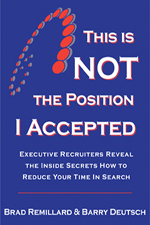
The first comment I get from candidates when I suggest these things is, “My resume will be too long.” No, it won’t. I have prepared thousands of resumes and I can get all of this on two pages. In fact, in our book, “This Is NOT The Position I Accepted” (CLICK HERE to review)  there is an example of a two page resume that contains all of this information. The person has over 20 years experience, so it is very doable.

Getting in the “A” pile is your responsibility, not the reader’s.

I wish more candidates would help us help them. All you have to do is give us the information we need to call you.

Contrary to what you may think, recruiters want to fill the position just as badly as you want the position.

For a FREE example of a cover letter CLICK HERE.

For a FREE example of a Thank You letter CLICK HERE.

For many more FREE resources and articles, join our Job Search Networking Group on LinkedIn. 4,300 people have done this. CLICK HERE to join.

I welcome your comments and thoughts.

Brad


Increasing Your Resume Response Rate – Audio Recording

Most resumes and cover letters end up in the trash can. The vast majority of resumes and cover letters submitted for a job posting DO NOT give a hiring manager or recruiter the incentive to pick up the phone and conduct an interview. Most Resumes and Cover Letters fail to match-up with the listing of expectations, skills, duties, responsibilities, results, and outcomes mentioned in the advertisement or job description.  Learn the behind-the-scene’s secrets on how to increase your response rate with recruiters and employers from Barry Deutsch and Brad Remillard, who’ve viewed millions of resumes over the last 30 years in their executive search business.

To download or listen to this recording CLICK HERE, then scroll down to the recording.

How Recruiters Read Resumes In 10 Seconds – Audio Recording

Recruiters screen your resume in less than 10 seconds for a few very simple reasons. Do you know the top 5 reasons why a recruiter will toss your resume into the circular file after a quick glance? Are you making simple mistakes and errors that consistently get your resume thrown into the trash? Learn how to overcome those resume mistakes that are preventing you from being interviewed.  In this radio program, Brad and Barry dissect, discuss, and recommend improvements to overcome the most common resume mistakes and errors that permit recruiters to read your resume in less than 10 seconds

You can read a complete and very detailed article on this topic. CLICK HERE

To download or listen to this recording CLICK HERE, then scroll down to the recording.

2 Types Of Resume Key Word Searches You Must Get Past

There are two types of resume key word searches. It is my opinion after having spoken with hundreds or maybe thousands of candidates that the vast majority focus on the wrong type. The result  is they rarely get a call back.

The two types of resume key word searches are (starting with in my opinion the least important):

1) The automated key word search. The most commonly thought of when most people think of key word searches. It is used by resume management systems. This is the type used by most job boards like Monster and Careerbuilder.

Although these play an important role, for the most part they play a much smaller role than most think. Granted for those screening resumes using the resume databases on one of the job boards, the key word search is important. But how many hiring managers, HR execs, CEOs actually spend a lot of time doing this? I have asked hundreds of these and very few claim they even use the resume databases. They are just too expensive. Most just run an ad and wait for the responses. Third party recruiters  and those companies that can afford on-site recruiters will spend time searching the databases, however, this is a small percentage.

The majority of  hiring is not done by large or Fortune 500 companies. Iit is done by the mid and small size companies.  The fact is most mid and small size companies can’t afford a sophisticated resume management system. This  then eliminates the importance of the automated key word search in the vast majority of hiring.

It is for this reason, coupled with the fact that most hiring managers don’t spend hours sorting resumes on the job boards, that I believe this is the least important of the two.

The hands down most important resume key word search is done 100% of the time by every CEO, HR person, hiring manager or recruiter. This is why it is so important. Yet, most candidates show complete surprise when in our coaching session I mention it.

2) The human eye key word search. This  is done with the eyes of the person scanning your resume. That person is looking for key words or phrases to jump off the page. They want their eyes to latch on to these as they move down the page. Most have trained their eyes to be on the lookout for these key words.

This is the key word search candidates should focus on. Yet so many candidates have a generic, one-size-fits-all resume that the key words are either missing,  buried so deep in a paragraph or are mentioned only once on page two of the resume, the key words or phrases are never noticed.

Here are a few suggestions to get past the human eye key word search.

Do you:

1) have the key words or phrases embedded multiple times in the body of the resume. Not just at the top of your resume.

2) have quantifiable results associated with your accomplishments. Don’t write out numbers. Actual numbers stand out more to the eye.

3) have the key words or phrases listed under multiple positions or companies.

4) have these words or phrases at the beginning of  the sentence or bullet point so the eye catches them. We read left to right. Don’t bury them in a long paragraph where it is hard for the eye to catch.

5) have them aligned with the advertisement or job description.

6) have them listed in your cover letter. You can download a sample cover letter for free that will show you how to do this. CLICK HERE to download.

7) have them re-enforced in your thank you letter. You can download for free a sample thank you letter that will show you how to do this. CLICK HERE to get yours.

These are just a few things you can do to get past the most important key word search – the person reading your resume.

In summary, if you do all the things necessary to get past the human key word search, I firmly believe you will by default have the proper  key words to get past the automated search.

For more information on building a resume that will get noticed and get you the call back, take a look at our job search workbook. It provides solutions to the most common mistakes candidates make during a job search.   Like this one. We will send it to you for just the cost of shipping ($5 USA only). CLICK HERE to learn more.

Join our Linkedin Job Search Networking group. Over 4200 people have. There is a wealth of articles and other resources for you in this group. CLICK HERE to join.

I welcome your thoughts and comments.

Brad Remillard


5 Most Frequently Asked Job Search Questions I Receive

On Friday’s from 9 – 10 AM PDT we often conduct free “Candidate Open Forums.” These are conference calls open to all of our candidates, in which we discuss topics and answer questions directly from you – our candidates. Unfortunately, we are limited to 50 people on the line at one time, so often we can’t get to all of the questions submitted ahead of time via email.

We believe these are important, so from time to time in this blog we will discuss the topics and questions we, 1) don’t get to during the conference call, 2) are asked over and over again (so these are probably on your mind too), and 3) just consider important for you to know.

Remember, we are retained executive recruiters so the answers and thoughts come strictly from that perspective.

1) Chronological vs. functional resume? Easy answer – NEVER, NEVER, NEVER, use a functional resume. In my almost 30 years of recruiting I have never had any recruiter or hiring manager support the functional resume. I have also been on many panels where all of the panelists agree to NEVER use a functional resume. Functional resumes just scream out,”Try to figure out what I’m trying to hide.” See our free audio file on resumes.

2) How do we overcome negatives such as age, turnover, time between jobs, etc? We believe you address them head on. If you have a negative, avoiding it doesn’t make it go away. We have a blog entry “Preemptive Strike” which you should also consider reading. If you have a negative item, you should bring it up straight away, discuss it openly and then whatever happens, happens. Don’t assume, “They didn’t bring it up so it must not be a problem.” They didn’t bring it up because they already settled it in their mind. You need to preempt any preconceived ideas before they come into play.

3) What is the best method and frequency for following up on a resume? For us, as recruiters, we prefer via email or one of the social media forums, Linkedin or Twitter. Recruiters have reduced staff just like many other companies, while the number of calls from candidates has skyrocketed. It isn’t possible to call every person. Email allows us to reply late at night, on weekends, or even while waiting in the lobby of a client. I can’t do that with phone calls. Regarding frequency, if in fact you are dead on perfect, then after two weeks send a follow-up email.

4) With so many top level executives in the market, how do you differentiate yourself from the pack? This is the 64,000 dollar question. We believe the best answer is to have a very compelling resume which is targeted specifically to the position. A generic, one size fits all resume will not differentiate you. That is what “generic” means. In today’s market our clients and therefore recruiters, are seeking very specific backgrounds. We are not looking for the proverbial, “Jack of all trades,” we are looking for the, “King or Queen for a specific role.”

5) Is negotiating with the employer different today due to the economic situation, and if so how? There is a difference given today’s market. For example, most companies will not relocate today especially in a large market area. Also, companies tend to be closed to severance agreements. If you aren’t working, they figure there is no reason to give an agreement and they are in control. You have to pick your issues and know where to compromise. This is all part of the pre-planning process for a job search. What issues will you compromise on and which ones should you dig in your heels?

You can download a free 8 Point Job Search Plan Self-Assessment that will help you evaluate exactly what you need to do to improve your search. CLICK HERE to download.

Is your Linkedin Profile going to get you noticed. Our FREE Linkedin Profile Matrix will help you develop an outstanding profile. CLICK HERE to download yours.

Join our LINKEDIN Job Search Networking group. Over 4200 people have joined. CLICK HERE to join.

We realize not everyone will agree with these answers and that is healthy. So if you don’t agree, or wish to comment, we encourage you to do so. Just click the link below.

Brad Remillard

5 Tips How To Keep Your Resume Out Of The Black Hole

Candidates constantly complain about how when they email resumes they all seem to end up in the proverbial “black hole.”

As a recruiter, who receives on average 6 to 7 hundred resumes a week, I can understand your frustration. I’m also sure I may not be able to eliminate it, however, I hope I can help you reduce it with these few tips.

1) When you move from candidate to hiring manager remember your frustrations and treat the people sending you resumes as you want to be treated now. You know, the thing our parents always taught us about treating others the  way we want to be treated. Sounds so obvious but I just wrote another article about how rarely this happens.

2) The best way to avoid the black hole in the first place is not enter it. If you include a cover letter; a) don’t send it as a separate attachment to your resume. It should be the first page when the resume attachment is opened. b) use either Word or PDF to send your resume. I receive many resumes I can’t open. c) your cover letter should be designed to grab the reader’s attention. That means the cover letter must clearly and with a simple glance align your background with the needs of the job. CLICK HERE and download a free copy of a sample cover letter that does just that.

3) You don’t have to be the first resume received. Most ads run for at least 30 days. Many candidates have experienced most companies take their time. So wait a few days or even up to a week or more before replying. Avoid being one of the first 400 resumes. After the first blast of resumes come, as more trickle in one or two at a time, I will often just open the resume take a look at it and make a decision how to handle it. These people avoided the rush and got their resume reviewed.

4) First try the personal approach. With number 3 above in mind, use this time to try and find a personal connection within the company or recruiting firm. There are many ways to do this. 1) Linkedin should be first on your list. This is  exactly why you need to build your connections to the maximum number possible. 2) Google the person’s name, position, or company name, anything that will help you target the right person within the company. Then look for a personal introduction. Most recruiters value a referral.

5) Don’t use services that blast your resume to 10,000 recruiters and/or companies. This is a major waste of money. What do you expect will happen when someone receives a bunch of unsolicited resumes? What would you do with them? How do you handle unsolicited emails? Most call it SPAM. It doesn’t work.

Hope these tips are helpful and now your resume will at least pop to the top.

Designing a resume is the starting point of every job search. If your resume gets screened out it is worthless.

If you didn’t know these little tips our Complete Resume System is designed to make sure your resume gets noticed. We guarantee it. The hundreds of people who have used this system to build an effective resume are getting their resumes read. You can too. There are many more tips you should include in your resume. For more information about getting your resume noticed check out our Complete Resume System. CLICK HERE to view it.

You should join our LinkedIn IMPACT Hiring Solutions Job Search Networking Group. It is free on LinkedIn and there is an enormous amount of articles and discussions to help in your job search. That is why over 4000 people have joined so far. CLICK HERE to join if you are a LinkedIn member.

You can also download for FREE a sample cover letter to use that will align your background with those of the company. CLICK HERE to download your sample.

I welcome your thoughts and feedback.

Brad Remillard

How to Give Your Resume a Booster Shot

Give your resume a booster shot and improve your ability to get interviews now!

Your resume needs a booster shot.

No longer is a simple 2 page resume enough to capture interest.

It’s boring.

It’s mundane.

It’s ineffective at fully telling your story (especially if you missed the last dozen or so blog posts that Brad and I wrote about putting together a good resume and cover letter – cycle back and read some of the posts first).

Along comes the explosion of social media/social networking and like magic – instant resume booster shot.

So, if social media/social networking is so darn powerful, why are so few executive and managerial job seekers NOT using it effectively?

Let’s zero in on one specific tool – LinkedIn.

LinkedIn could be a panacea for job seekers. First, almost all recruiters, HR people, and hiring managers are doing two things when they see a resume that is a potential match for their open position – they Google your name and they search for you on LinkedIn.

Personally, I go to LinkedIn first.

  • As a Retained Executive Recruiter, I want more information about you.
  • I can’t get enough.
  • I’m insatiable when it comes to learning about who you are even before I pick up the phone and talk to you.
  • I’m trying to leverage my time, and this discovery process is far quicker than wasting time on the telephone.
  • I want the kind of depth of who you are that I cannot glean from your resume and cover letter.

This approach to researching job seekers is becoming more common.

Don’t be the one who misses the train.

You’ve now read about it in almost every business publication, heard from the experts, read about it on blogs such as this one, and your mother last week pointed out the growing importance of building your profile on-line when she saw the segment on the CBS evening news.

Unless your resume literally “blows me away”, I need more information to decide if I want to talk with you about one of my open executive searches. By the way, I might come across one resume every quarter that “blows me away”. Most just fade into the woodwork with their “bland” approach. I want your information to leap off my computer screen, smack me in the forehead, and scream at me that I would be an idiot not to want to learn more about you by immediately pick up the phone to talk with you.

Don’t fall victim to being “vanilla”

Don’t fade into the woodwork.

Some might call me lazy – I prefer to think of myself as highly effective at leveraging myself in time management. This process of quickly discovering whether you’re worthy of a phone call from me as recruiter – by matching your resume with your LinkedIn Profile has probably boosted my productivity by a factor of 2X-3X. I’m now able to spend time on the phone and in-person with the right candidate.

In the next few blog posts, we’ll re-visit how to specifically leverage LinkedIn as a Job Seeker to give your resume a booster shot in the arm. If you’re not effectively using LinkedIn as a resume enhancement tool, shame on you. If you’re not even on LinkedIn and you’re a manager or executive – sorry – but the train has left the station without you!

Here’s a suggestion I would like to toss our to our readers: In preparation for the next blog article in this series titled – “Job Search Marketing 101 – Your LinkedIn Profile Heading”, I would encourage you to complete our one page scorecard for assessing the effectiveness of your LinkedIn Profile for Job Search.

Download our FREE LinkedIn Profile Self-Assessment

Thousands have used this FREE tool to dramatically give their paper resume an on-line booster shot in the arm. Now armed with your self-assessment of your LinkedIn Profile, you’ll be well prepared as we dive deeply into the various components of leveraging LinkedIn to create a powerful online personal brand for yourself, a powerful magnet to attract recruiters and hiring managers, and a beautiful enhancement to your resume that was not possible just a few years ago.

Barry Deutsch

Join the conversation in our LinkedIn Discussion Group as other managers and executives discuss how they’ve leveraged LinkedIn to give their resume a booster shot.

Does Your Resume STINK? Is that the problem?

Holding your nose because your resume stinks

Did you know that the number one reason most candidates don’t get called for an interview after submitting a resume is that their resume and cover letter STINKS?

Reminder – LAST CHANCE to take Advantage of our Special One-Time Resume and Cover Letter Webinar tomorrow — Friday – January 29th – Special Appreciation Rate and Bonus Materials


If you’re not getting a high number of “bites” on your resume when you forward it to networking contacts and submit it to employers for their job postings, perhaps the problem is not so much with the economy – but rather in the document you’ve created to market yourself.

Can you afford to have a resume and cover letter that STINKS?

No wonder the average time for a manager or executive to find a job is creeping beyond 6 months into the 12-18 month plus time period.

How many months will you continue to deplete your savings account and base your job search on hope and luck by using a resume and cover that STINKS?

We’ve put together a very special webinar for the members of our job search community. One hour is all it takes to learn how to create a powerful marketing document that grabs employer’s attention and makes them want to pick up the phone and call you.

The best news is that we’ve cut the price in half for our loyal readers and followers and we’ve thrown in a few HOT items that will help your job search. You’ll NOT find a less expensive webinar packed with as many ideas – tactics – and helpful advice anywhere on the Internet.

Learn the inside secrets of creating and leveraging a power marketing document to get interviews and finish your job search quickly.

Join us for this webinar (probably will only be offered ONCE this year) which is special appreciation webinar for our job search community of loyal readers and followers.

Click the link below to take advantage of this unique private offer to our job search community reducing the normal fee for the webinar from $89.95 to $39.95 and the inclusion of two of our HOT audio programs – a total value of over $150.00.
Last chance to sign up TODAY. Click this link to register now:


SIGN UP-GET MORE INTERVIEWS WITH YOUR RESUME

Join me on Friday January 29th at 9 AM to start conducting an effective job search NOW!

Barry Deutsch

Photo courtesy of megngarnett

Cover Letters Are Worthless And Outdated

I started recruiting in 1980, and in that thirty years I have either run or owned executive search firms. IMPACT Hiring Solutions is a very active executive search firm. For the first fifteen years I worked mainly in the finance and accounting field and most of the searches were contingent, meaning I got paid when the company hired a candidate that I presented to them. Until then I worked for free.

In the last fifteen years I have shifted to a retained recruiter and now my searches cover just about every functional area from HR, Sales, Finance,Operations and so on. Now as a retained recruiter I get paid when I start the search and as the search progresses.

This is only relevant to demonstrate that I have had a lot of opportunities over the last thirty years to see how recruiting and the hiring process has changed. I have been able to interact with just about every functional area in a company with literally thousands of hiring executives, HR professionals and CEOs to observe their practices. I’ve watched them screen resumes, I’ve asked if they want or read cover letters, what grabs their attention and what turns them off, what resume format they prefer and how long a resume should be.

The plain fact is that one can’t do anything for thirty years and not learn something.

HIRING HAS CHANGED

With the invention of the Internet hiring changed. It continues to evolve even today with the explosion of social media and sites such as LinkedIn, Twitter and Facebook. When I started thirty years ago we hadn’t heard of a fax machine. Resumes and cover letters were all sent via snail mail. If that wasn’t bad enough, they were typed one at a time on a typewriter (for those of you too young to know what a typewriter is Google it for a picture or the Smithsonian has them to view). Every tiny change meant you had to retype the complete resume. Cut and paste didn’t exist.

Hence the need for the “cover letter.” Back then customizing a resume meant you had to retype it yourself (and most people back then didn’t type) or paying someone to type it which wasn’t practical or affordable. So instead, candidates added a cover letter to highlight areas in their background to match the position. Some cover letters were even handwritten and that was acceptable. Back then, the cover letter served a valuable and practical purpose.

Fast forward to the 21st century. With laptops being as common as toasters, the invention of word processing, email, social media and the fact that everyone can type, the ability to customize a resume to a specific position can be done in a matter of minutes. Hence, the traditional cover letter lost its purpose and value.

But just like a government program, once it starts it rarely goes away, so the cover letter continues to live even though it is no longer useful (just like many government programs).

THE PROBLEM TODAY

All of the controversy today about cover letters lingers because so many candidates don’t know what to do or how to do it. As a result, they rely on outdated information, that is how we have always done it or that is the way we did it thirty years ago. Yeah, and my dad walked thirteen blocks everyday to school in the snow, sleet, pouring rain and without boots. Well, my kids didn’t do that because times have changed and some things just out live their usefulness e.g. 5.25 floppy disks, 8-track cassettes and DOS programming and the cover letter!!!

THE SOLUTIONS TO WORTHLESS COVER LETTERS

Cover letters can serve a purpose even today. They can still be used to highlight how your experience and skills align with the job. But that is it.

Candidates still use cover letters as a way to update their resume instead of rewriting it. They put information in the cover letter that should be in the resume and figure that it’s acceptable. WELL, IT IS NOT ACCEPTABLE.

A cover letter today should be used like a sound bite in a commercial. It should grab the reader’s attention and get them interested enough to read your resume. Then, when they read your resume, they should find not only everything listed in the cover letter, but additional points of interest that distinguish you from all of the other candidates.

Your cover letter is simply a short advertisement about how you align with the open position, so that the reader is compelled to read your newly rewritten, focused and targeted resume for their specific position.

TO COVER LETTER OR NOT TO COVER LETTER – THAT IS THE QUESTION

Should you have a cover letter or not is another point. I say “YES.” Only because over the years many HR professionals, CEOs and hiring managers have told me that they want one. They believe it is polite and a professional introduction. It is true that many don’t care if you have one or not, but it is better to have one for those that want one, and those that don’t care will just ignore it and move on.

One more way we can help you is to speak directly with you utilizing our webinars. Our time and knowledge is valuable so YES, we do charge a nominal fee for the webinar. To balance that, we also offer a lot more tools and resources for FREE than what we charge for.

We’ve DEEPLY DISCOUNTED THE WEBINAR FOR THOSE JOB SEEKERS WITHIN OUR JOB SEARCH COMMUNITY – loyal followers on Twitter, readers of our blog, and members of our LinkedIn Job Search Discussion Group.

In a lively one-hour presentation, I’ll show you the inside secrets (from a retained executive recruiter’s perspective) of how to get your resume reviewed every single time and boost your resume acceptance rate (the number of times you get called for an interview from submitting your resume) from a dismal level of less than 10% to well into the 50% PLUS RANGE. If you’re reading this blog, when you sign up for the webinar use the coupon code IMPROVEMYRESUME.

If the small, inconsequential, almost non-existent fee for the webinar is too much to bear to boost your resume acceptance rate and cut your job search time dramatically, please feel free to download our many FREE resources for job seekers, including our radio show broadcasts, cover letter sample, and other tools.

You can download for free a sample cover letter that aligns your background with the position and is not a substitute for the resume. CLICK HERE to download your sample cover letter.

Join our LinkedIn Job Search Networking Group for vibrant discussions, articles and much more information to help you in your job search. CLICK HERE to join the 3600+ LinkedIn members that already have.

I welcome your thoughts and comments.

Brad Remillard