Category: Personal Branding

Don’t Be Like Groucho Marx – Job Search Tactic #2

Networking Through Joining LinkedIn Groups

Groucho Marx once said “I don’t want to belong to any club that would accept me as a member.”

Groucho must not have been conducting a job search when he made that comment.

Joining Groups (like clubs) on LinkedIn is an excellent way to engage with people who hold a similar interest, make new contacts, network, and discover hidden job opportunities.

Your groups display on your LinkedIn Profile. When I click your profile, I can see which groups we have in common. As a recruiter, I usually focus on searches within groups first due to the ease of contacting other group members.

Here are some of the parameters on joining groups on LinkedIn:

LinkedIn allows you to join 50 groups

You can post roughly 7500 news feed items per 24 hour period. These can be multiple feeds within the same 24 hour period into the same group. I have not yet done a test to ascertain the precise number.

You can post unlimited discussions (I have not come across a limit yet within a 24 hours period. Again, I’ve not tried to test the system by posting more than 50 in a 24 hour period.

You can send messages to other group members without using your valuable inmails nor do you have to know the email address. I’m not sure if there is a limit on the number of messages you can send directly to group members. I have yet to hit it if there is a limit.

What groups should I join you might ask?

  • Your alumni group
  • Geographically based network groups for individuals in your city
  • Association or trade groups that focus on your industry, such as Construction or Telecommunications
  • Functional specialty groups, such as those for VPs of Marketing or CFOs
  • Charitable groups that focus on causes you support
  • Job Search Groups, such as the IMPACT Hiring Job Search Discussion Group

Now that I’ve joined a few groups, what should I do next?

Even though in a previous post I suggested you not be a lurker, I give you permission to do short-term lurking. Gain a sense of the culture of the group. Review the other messages in the group first.

  • Are group members discussing job search related issues?
  • Are group members supportive of each other?
  • What type of news feeds are being posted into the group?
  • Are there job leads being posted by group members under the jobs tab?
  • How passionate are group members in responding to questions or discussion points?

You’ve lurked long enough – it’s time to jump in and become a valuable and active member of the group.

What kind of benefits might I expect from the time investment of doing all these activities within all my groups:

  • You’ll be enhancing your PERSONAL BRAND by establishing your involvement, focus, and expertise in the various groups.
  • Others will be attracted to you and want to connect with you on LinkedIn directly
  • As Hiring Managers and Executives frequent these groups, you’ll become noticed by the individuals who may someday hire you
  • You’ll be starting to dramatically expand your connections and the massive net it takes to capture hidden job market leads and referrals.

Barry Deutsch

P.S. Don’t forget about the Webinar my partner, Brad Remillard is teaching on March 26th, titled “How to Find Your Next Job on LinkedIn”. See the promotion for the Webinar in our right-hand sidebar.

Stop Being a LinkedIn Lurker: Job Search Tactic #3

Lurking on LinkedIn - A Major NO-NO for an effective job search

Sounds like something you could be arrested for – maybe even a felony conviction.

Seriously, if you want to take your job search to another level, you’ve got to engage in communicating and interacting on the primary social media forum for professionals, managers, and executives.

Studies show that 90% or more of all users of social media (including LinkedIn) are lurkers.

What the heck is a LinkedIn Lurker?

A lurker is someone who reads the news feeds in groups, reads the questions in groups, reads the questions and answers in the Q&A section, and observes the status updates of those to whom they share a 1st degree connection.

Are you a LinkedIn Lurker?

YOU CANNOT CONDUCT AN EFFECTIVE JOB SEARCH BY LURKING?

Lurking is like hiding behind your mother’s skirt when you were 3 years old. Why do we do this as intelligent, sophisticated, cosmopolitan, confident adults? I wrote another article a few months ago on this same subject titled “STOP Being A Job Search Voyeur – Let Your Voice Be Heard

I don’t get it.

I don’t even buy the introversion excuse since you’re not having to meet these people on-line or build a deep relationship. There is no rejection phobia here either.

Engaging in the conversation on social media sites like LinkedIn, Facebook, and Twitter is just about the most friendly, safest environment to give your job search a little booster shot in the arm.

Here’s a few simple things you could start doing right now:

  • How many of you are posting questions in our LinkedIn Discussion Forum and how many of you are helping others in the Group by answering/commenting on the discussions they started?
  • Are you looking at the wealth of news feeds in our LinkedIn Discussion Group and commenting on those valuable links?
  • When was the last time you commented on a connection’s status update?

We’ll tackle further engagement on LinkedIn in future tactics.

By the way, My Partner, Brad Remillard, will be leading a webinar on March 26th on how to leverage ALL the different elements of LinkedIn to conduct an effective job search.

Click on the link in our sidebar to learn about this very popular webinar.

If there was one place you could invest your time and get the biggest bang for the buck, it would on LinkedIn. Sadly, most job seekers are not leveraging even 10% of the tools, personal branding, engagement opportunities, and other inexpensive techniques to help themselves be found.

Brad and I did a couple of Programs on LinkedIn in our Weekly Radio Show. You can download these from our FREE Job Search Audio Library.

You know it’s much easier to be found than to find the right job.

What’s holding you back right now from signing up for a one-hour webinar (from one of the top experts in this country on using LinkedIn) in which you’ll learn at least a dozen core tactics that you’ll use every day in your job search?

Barry Deutsch

If you’re NOT a member of our LinkedIn Job Search Discussion Group, JOIN US NOW to start your engagement process and move beyond lurking.

LinkedIn – Your Online Resume is Worthless

This is where your online resume - LinkedIn Profile - ends up most of the time

Not having an effective LinkedIn Profile for your job search is the same as having an ineffective resume that gets tossed into the trash can all the time. STOP letting your online resume (LinkedIn Profile) be thrown in the trash!

LinkedIn provides an extraordinary online tool – your profile – a virtual resume and portfolio for you to do personal branding, self-promotion, and lay out a portfolio of your abilities, skills, and accomplishments.

The entry level account is FREE. This is the proverbial “no-brainer”. So, why are most profiles WORTHLESS? Why don’t professional job search candidates at managerial and executive levels consider this an important part of their job search?

TEST OF LINKEDIN PROFILES FOR JOB SEARCH

I’m in the middle of conducting a retained executive search for a Sales Executive. Like most recruiters, I’m using the search function in LinkedIn to find executives in specific industries and geographic areas. Everyone knows that LinkedIn is a significant tool for sourcing in the hands of recruiters, human resource professionals and hiring managers. I’m only searching for candidates that have flagged their account that they are open to career opportunities. I’ve now reviewed over 400 profiles.

Less than 20% have anything beyond a “skeleton” set of information.

Less than 2% have a decent profile fully completed with extensive descriptions of their accomplishments, an outstanding summary, lots of recommendations, and have their contact information (such as phone number and email address) available.

Less than 1% have taken the time to really leverage all the tools LinkedIn provides on your profile – slide presentations, attaching documents, reading lists, linking your blog and twitter accounts, and on the list goes. It’s absolutely amazing the value LinkedIn provides to job seekers.

As a recruiter reviewing profiles, it takes me about 5 seconds to look at a profile and make a first impression of whether I want to continue looking at it. If the profile is not complete, I will not bother to spend any more time with that potential candidate. You’ve just missed an opportunity which could have been the ideal job to move your career forward after you’ve been out of work for 9 months.

CONFUSION – WORTHLESS LINKEDIN PROFILES

I DON’T GET IT!

WHY DO THE VAST MAJORITY OF JOB SEEKERS HAVE A WORTHLESS ONLINE RESUME (LINKEDIN PROFILE)?

IS IT NOT TIME TO FIX THIS OBVIOUS OVERSIGHT?

HOW MANY JOB OPPORTUNITIES HAVE SLIPPED BY YOU BECAUSE RECRUITERS LIKE ME HAVE SKIPPED OVER YOUR WORTHLESS ONLINE RESUME (LINKEDIN PROFILE)?

IMPROVE YOUR LINKEDIN PROFILE NOW

Brad and I have spoken extensively about the need to fully flush out your LinkedIn Profile as one of the tactics in an effective job search. We’ve talked about it in our weekly Internet Radio Talk Show. You can download the specific episodes about LinkedIn from our broadcast archive.

We even put together a FREE one-page LinkedIn Profile Self-Assessment Scorecard to determine if your LinkedIn Profile is effective in being found by recruiters, HR professionals, and hiring managers. You can download the Scorecard right now and frighten yourself on your inadequate profile. You might want to also bang your head on the wall a few times over the potential job opportunities for which you’ve been ignored.

Take action right now and fix this simple element of your job search. STOP being ignored. Create a profile that allows you to instantly capture the attention of recruiters, HR professionals, and hiring managers that are looking for someone JUST LIKE YOU.

Barry Deutsch

Don’t forget to join our LinkedIn Job Search Discussion Group and learn how to improve the effectiveness of your job search through leveraging the tools LinkedIn provides to create a powerful job search profile.

Personal Branding Blog Articles in 2009

Can you stand out from the crowd in your Job Search Personal Branding or do you blend into the background?

Learn how to stand out from the crowd – differentiate yourself and grab the attention of recruiters, human resource professionals, and hiring managers.

Below is a list of our best personal branding articles in 2009. I’ve started to see a number of blog authors write postings saying something like “the only solution”, the only tip you’ll need”, the only piece of advice you need to read” and other similar nonsense.

Perhaps these are attempts to be cute with blog titles – no one in their right mind could possibly think they’ve cornered the market on personal branding, job search, and networking advice. That’s just plain silly. There is no one right answer or perfect tactic. There are some best practices you could follow, such as having a good professional picture on your profile, fully filling out your LinkedIn Profile, creating a Google Profile, and so on.

There are a lot of charlatans writing career and job search articles that have no expertise on which to base their advice. Be careful of these scams and poorly written articles that could actually damage or delay your job search. On the other hand, there are some outstanding experts in the blogosphere writing exemplary articles on these subjects. There are individuals who have established their brand, proven their expertise, and give great advice. You should be following them and hanging on their every word. In a few upcoming blog postings, I’ll share with you those bloggers whom I think are worth following.

Here are some of our best articles (measured by readership, tweeting activity, and comments) on job search personal branding for 2009:


Your LinkedIn Profile As An Expanded Multi-Media Presentation of Your Resume

Does Your Personal Branding Efforts stand out in a crowd or fade into the background - very important for differentiation in an effective job search We discuss the various tools LinkedIn provides to enhance the typical resume and provide an extensive portfolio of your expertise, skills, accomplishments, and value. Learn how the “free” tools provided on your LinkedIn Profile Page can dramatically be leveraged to enhance your job search personal brand.


Have You Assessed Your LinkedIn Profile Yet?

Can you afford NOT to take the time to assess the effectiveness of your LinkedIn Profile for determining if you are conducting an effective job search?

We launched a FREE LinkedIn Job Search Profile Self-Assessment Scorecard and it became one of the most downloaded FREE tools we’ve ever created. Over 2000 job search candidates have downloaded this quick one page assessment tool and shared with us the feedback that they now get found more easily by recruiters, human resource professionals, and hiring managers.


Become a Beacon in Your Job Search

Set yourself apart from your peers through personal branding in your job search

Are you a beacon of light in your job search? Do you “stand-out” in your job search. Are you a light unto others in your job search? A significant part of job search personal branding is casting a light so bright that those who are interested in your background will see you long before your peers come into view.


Barry Deutsch

Don’t forget to join our LinkedIn Job Search Discussion Group to learn from others the best practices in personal branding and how to conduct an effective job search.

One Simple Trick To Finding A Job

So many candidates struggle with finding a position. I’m not going to insult you by telling you it is easy. It isn’t. In fact, for most it is hard work. Mainly because this may be new to you and with the exception of a few, this is not your area of expertise. It is always difficult to do something when  you are not an expert. In fact, it is frustrating because most professionals make it look so easy. Have you ever watched one of those home improvement shows do a complete kitchen remodel in just 22 minutes? They never have any problems, everything fits the first time, they never cut a board wrong, and it looks great in the end. Have you ever done a kitchen remodel and have it done that easily?

Their remodel happens so easily because they are an expert in it and we are not. So how does this relate to finding a job?

Companies in today’s market want the expert. They don’t want the jack of all trades, they want the king or queen.

Candidates have a very hard time accepting this. It is better to be great at one thing than good at many. Experts do 1 or 2 things 10,000 times, not 10,000 things once or twice.

What is your expertise? What unique passion, unique experiences, unique skill set, unique talent, unique accomplishments do you have that will, if not separate you from the 100’s of resumes received, at least get your resume to the pile of 5 to 10 to interview?

We live in a 140 character world. Millions tweet thoughts in 140 characters or less. Status updates on Linkedin are 140 characters or less. Can you describe your expertise in such a way that you stand out in 140 characters of less?

If not, then this is a great thing to work on over the holidays.

For example:

  • A CFO with extensive experience in international finance within X industry and X sized companies
  • Sales professional that enjoys the challenge of cold calls, increased first time customers by X% in first year directly by cold calling.
  • HR executive that excels at union neg, reducing benefit costs by X% and 70% of hires from employee referrals up from 20% when I started.

These are just some examples that at least help you stand out, identify your unique strengths and accomplishments.

I have worked with hundreds of people helping them identify what makes them unique. It always starts out the same, “I’m probably not all that unique. I do my job and so do others.” That may be true, but every person doesn’t do the same thing, even in the same functional area.

Think about becoming great at 1 0r 2 things instead of good at many. Do this, and watch how your job search results change.

If this was helpful to you, then help others in your network by passing it along so they also benefit. Helping others will always help you in your job search. You can add this to your status on Linkedin, tweet it, add it to your Facebook page, or email it to your network. Let’s help everyone that is seeking a new job.

For more help on this, join our Linkedin Job Search Networking group. It is free and loaded with helpful discussions and articles. CLICK HERE to join.

Get our FREE 8 Point Job Search Self Assessment Scorecard to evaluate your job search. You can’t fix it if you don’t know what is broken. This will help you. CLICK HERE to get yours.

You can also get a FREE sample cover letter proven to get you noticed. Thousands have downloaded this, and it is FREE. CLICK HERE to get one.

I welcome  your comments, thoughts and questions.

Brad Remillard


How To Leverage Your Network And Get Others To Help You

Most everyone in the market is out doing all the networking they can. Sooner or later they will hear the saying, “Networking is about helping others.” or “Networking is giving before getting.” Both are true and critical to a successful networking process.

But what exactly does this mean? How do you implement this concept?

My experience has been that most are more than willing to help out when asked. Most will make introductions when asked. This is great, but there are other things one can do to give and help others. Even when not asked.

I think one of the best things you can do is share information. My partner Barry and I try to do this daily. We post articles so others can read them and benefit from our 30 plus years of experience. From time to time we will get an email thanking us. In fact, I received one today which was the catalyst for this article.

Here are other ways you can help others.

  • How often do you forward articles  you found helpful to your network?
  • How often to you post the link to your Facebook page allowing all your friends to benefit?
  • Do you post the discussion or forward the article to your Linkedin groups?
  • Do you share it with your Linkedin connections?
  • Do you Tweet and include the link so all of those following you can benefit?
  • Do you make announcements at networking meetings about how you benefited from this article?
  • Have you passed along YouTube videos that you found helpful?

Do you do this? Do you do it on a regular basis out of habit?  Or like many, do you  just read the article and never think about proactively helping others? If you benefited from it so will others.  Just one right tip from you, one article reaching the right person at the right time, may help them land an interview or even a job.

Sharing information is just as important as sharing leads. I could make the argument that it’s more important. Leveraging your network by helping others, makes others want to help you. People generally want to repay those that have helped them.

It is also a tremendous way to keep in touch with people without bugging them. You are helping them and they will appreciate it. So stop worrying about bugging people in your network, instead start helping them by passing on helpful and informative information.

I would like to challenge you to not wait until people seek your help, instead be proactive. Send them information you find helpful so they can benefit. I bet you will start getting emails thanking you for helping.

What a great way to be branded as a ” giver.”

I think this is an excellent way to continue to engage your network and at the same time help others.

Isn’t that what true networking is about?

If this was helpful, then please help others by forwarding on to your network, posting on your Facebook page, Tweet with the link, post to your Linkedin groups or status update.  Let’s all do everything we can to help those looking for employment.

For lots of articles and great discussions to start sharing, join our Linkedin Job Search Networking group. CLICK HERE to join.

Download our free sample cover letter that is proven to get results. If you like it, you can share it with others. CLICK HERE to download.

Build a compelling Linkedin profile to  help  you get noticed by recruiters and hiring managers. Our 8 Point Linkedin Profile Assessment Tool can help you. CLICK HERE to download yours. Then share it with others that don’t have a compelling profile.

Brad Remillard

Stop All This “Personal Branding” Nonsense

It is hard to be in a job search today and not run across two, overused and misunderstood terms, one is “networking” and the other is “branding,” usually “Personal Brand.” How did these words become the “buzz words” the “must do” the “most important,” words so critical that if you don’t do them, you are sure to fail in your job search?

Who makes this stuff up? They’re the marketing geniuses.

The number of books, blogs and news articles written on “Personal Branding” continues to grow. If it takes that much to explain “Personal Branding” it may just be too complicated to begin with. It’s as if this is some new concept in job searching or as if the “holy grail” of conducting a job search has finally been found.

NONSENSE.

All that has happened is that some marketing person put a clever name to it. It’s as if once you “brand” yourself you will be the NIKE, Apple, Coke, Michael Jordon or Tiger Woods in your field or industry.

Silly me, for 29 years as a recruiter I’ve just referred to this as, “differentiating yourself” or “making yourself unique.” I didn’t know I was telling my candidates to “BRAND THEMSELVES.” I’m not sure that is all there is to a brand, but it pretty much sums up all you have to do in a job search.

It’s not so complicated that it takes a 200+ page book to explain it.

For the sake of appearing up to date and current, it is critical in any job search to communicate “why” you are different from your competition. What unique skills, traits, talents, accomplishments, experiences and passions do you bring to the party? If you can’t define these, you are a commodity. The problem with being a commodity is that the only thing you have to negotiate on is price. In a job search price is compensation.

Call it “branding” or something else, we can’t stress enough that every candidate needs to step back and take some time to determine what makes them unique. Often each position may require a different set of skills, experiences or talents. It is possible that you may have to differentiate (oops brand) yourself differently for different positions. It also means that you may not be the best qualified candidate for every position.

Do a S.W.O.T. (Strengths, Weaknesses, Obstacles and Talents) analysis of yourself. List them out. Once you have the list, for the S and T, identify accomplishments and examples that demonstrate these strengths and talents. For the W, develop a plan to work on improving your weaknesses and for the O develop a plan of action to overcome any and all obstacles in your way to getting the position you want.

So forget about “Personal Branding,” it is way too complicated and probably just a fad. Just get back to the basics and figure out what differentiates you from all the others like you. Then go market it.

In the future you will see articles I write on “Personal Branding.” I will even title the article using the word “branding” because if I don’t, nobody will read it. So I will reluctantly conform.

Conformity has never been a “brand” for me.

Our job search book provides a template called,”Personal Success Profile.” This will help you identify what makes you different and add guidance for completing the SWOT analysis. You can get this for just the cost of shipping $5. CLICK HERE to review the book.

Listen to our talk radio show every Monday at 11AM PDT on www.latalkradio.com. It you miss it, you can download all of our past shows from our Web site. CLICK HERE to review the past shows and download the ones you want. All are free.

Please give us your comments and feedback.

Brad Remillard

When In-Transition You’re A Salesperson-So Act Like One

At a recent networking meeting of fifty to sixty senior executives, all VP and C level, which included a mix of all corporate functions the following question was asked:

“How many of you are in sales?”

Only about 10% raised their hands, until someone flippantly yelled out, “We are all in sales.” The rest of the group then caught on and hands starting going up. Still, only about 50% raised their hands.

The moderator then followed-up with, “OK, what are you doing to demonstrate you are really in sales? For example, what books on sales have you read, how do you consciously incorporate sales into your search, how many have taken sales courses, courses on closing, written your resume with sales or marketing in the forefront of your mind, etcetera?”

Then he asked, “Anyone in finance and accounting, such as controllers or CFOs?” A few raised their hands.

His next comments brought the point home when he said, “So if I’m a sales professional, say a VP Sales and I’ve done a budget, I suppose I’m qualified for your job. I shouldn’t need any training, don’t need to read any books on accounting. I just say, ‘I’m a CFO’ and that makes me a CFO.”

Of course the group was snickering and laughing at such a silly statement. Yet they could all be sales people without any training. Isn’t that equally as ridiculous?

What they were really saying is, “When in-transition, everyone is in a sales role.” However, being in a sales role doesn’t make you a salesperson.

Most candidates don’t really know what it means to be a salesperson. They intellectually understand the concept, but don’t know how to take the concept and put it into practice.

Transition requires a candidate to change their perspective. Candidates have to understand that whether they call it sales or not, whether they are comfortable with it or not, they are not just in a sales role – they are a salesperson. They have moved out of their comfort zone and into a sales and marketing environment. Even salespeople don’t seem to grasp this concept while in-transition. It is for this reason that we recommend getting a sales and marketing consultant to assist you.

Just saying you are something doesn’t make you that. You need to learn how to become a salesperson. This includes, prospecting, overcoming objections, what a sales presentation is, knowing your competition and why you are better, identify why you are different from all the rest, having a sales pitch, and so much more. You need to read a few books on sales, attend a sales training webinar or course, practice your sales presentation, and get prepared just like a true professional salesperson does.

So please stop saying you are in sales and go out and become a salesperson.

Get our FREE Personal Job Search Self-Assessment Scorecard to find out if you are acting like a salesperson. CLICK HERE to download your FREE copy.

Download our FREE example of a cover letter to make sure you are selling to the what the customer (hiring manager) is really looking for. CLICK HERE.

Please give us your feedback and comments.

Brad Remillard

Advice on Personal Branding is NOT Useful

Step-by-Step Approach to Developing a Powerful Job Search Personal Brand

The current popular buzzword of job search personal branding has taken on an almost mythical status.  Almost every article and blog in the job search arena talks about personal branding. Yet, almost all the recommendations and suggestions are so generic that the advice on job search personal branding is NOT useful.

Good intentions – not enough concrete step-by-step tactics for your job search!

Where do you start – what process do you use?

Are there forms or templates which organize your creation of a personal brand?

What are the best practices in job search personal branding?

What works and what doesn’t work?

How do you leverage your time to create the most powerful personal brand possible?

Most of the so-called “experts” miss the most important STEP in Job Search Personal Branding:

What do you have to do before creating a personal brand? How do you specifically STEP-BY-STEP build a defining document that leads to the creation of your job search personal brand. Telling you to create a personal brand is what I term a BHAG (pronounced Bee-HAG), which stands for Big-Harry-Audacious-Goal. BHAG objectives and recommendations sound like:

Get more sales

Achieve market share

Improve Quality

Achieve the gross margin goals

Raise the number of inventory turns

Establish a personal brand for yourself


The secret behind creating a powerful job search personal brand:

Start at the execution level INSTEAD of the BHAG level. Don’t worry about having a personal brand until you’ve gone through the rigorous process of defining who you are and what you want.

What is this rigorous process you might ask?

We call it the Personal Success Profile and it is the Number ONE Step of our comprehensive job search system called the Career Success Methodology.

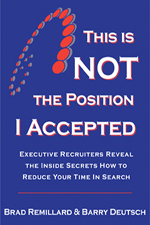
Thousands of job seekers who have read our new job search workbook, This is NOT the Position I Accepted (a step-by-step workbook to use the Career Success Methodology in your job search), have embraced the process of first creating a Personal Success Profile as the starting point in their job search. Every day, Brad and I receive email messages on how candidates conducting a job search have dramatically reduced the time it takes to find a new great job – and it all started with the creation of a Personal Success Profile.

Before you can develop a job search personal brand, you’ve got to go through the creation of a Personal Success Profile (PSP). This exercise in creating a PSP will help you to develop a strong personal brand, a networking plan, a targeted job search plan, and prepare for interviews. It becomes your guiding light that dictates every move you make in your job search, including how you create your personal brand.

Your Job Search Personal Success Profile defines your capability, competency, skills, knowledge, values – all the key elements a prospective employer might want to know about you. It captures the core elements of what differentiates you from your peers – part of which is your personal brand.

The PSP goes a step further in creating a definition of what’s important to you in a new job – from the type of boss for whom you might work to the type of culture in which you might flourish.  This Profile identifies what you’re willing to sacrifice in accepting a new job and what items are non-negotiable. The PSP provides the foundation for your entire job search.

Get a copy of our book, This is NOT the Position I Accepted, to learn how to create a Personal Success Profile, listen to our Audio Program on building a PSP, or use the comprehensive Job Search Home Study Kit to get a kick-start on moving your job search into high gear.

Brad and I have also discussed the need to start your job search by creating a Personal Success Profile in our weekly Radio Talk Show. You can listen and download our previous episodes to learn why creating a Personal Success Profile is the number one element of success in your job search.

If you’ve downloaded our FREE Job Search Plan Self-Assessment Scorecard as a tool to improve the effectiveness of your job search, you’ll notice that the first item on the matrix is whether you’ve developed a Personal Success Profile.

Barry


P.S. Don’t forget to join our LinkedIn Job Search Discussion Group to participate in learning how to reduce the time it takes to complete your job search, especially the discussions around developing a Personal Success Profile that leads to a powerful Job Search Personal Brand.

Job Search: On-line vs. In-Person 1st Impressions

Job Search Effectiveness: On-line Job Search vs. In-Person First Impressions

Chad Levitt, a guest blogger at Dan Schwabel’s Personal Branding Blog posted a blog a few days ago titled “What is Your Digital First Impression?” Chad claimed that making a digital first impression was very similar to making a personal first impression. He inferred in the blog posting that when people are searching for you on google, those first few links that come back are your first impression.

By the way, Chad is an extraordinary authority figure on personal branding, particularly in networking and sales. His own blog at The New Sales Economy Blog is one of my favorite.

No disrespect intended, but I think Chad may have defined digital first impressions a little too narrow.

In a personal meeting, you typically have one chance to make a good first impression. Blow it – and it’s over. Rarely will you have another opportunity.

On-line, first impressions are radically different. Not only are your first impressions scattered across a wide array of sites, such as LinkedIn, Google, Facebook, forums, discussion groups, Twitter, and many other indexed sites/comments.

Not only is your first impression scattered across a wide variety of sites as compared to a one-time event in person, you also have the ability to constantly improve, manage, build, develop, and evolve your first impression on-line. What appears today in a Google Search is NOT what has to appear next week.

The major question is: are you continuously working on your digital first impression so that you can be “found” by buyers, hiring managers, senior executives, recruiters, and human resources?

Let’s tackle one small area of starting to more effectively manage your digital first impressions: A few months ago, we posted on our website an 8-point Success Matrix to evaluate the effectiveness of your LinkedIn Profile. The scorecard was intended to determine if your LinkedIn profile was strong enough to let you be found by hiring managers, recruiters, and human resources.

Our research around the use of LinkedIn as a Personal Branding Tool and for Job Search 1st Impressions was depressing. Less than 10% of those who took the challenge to assess their LinkedIn Profile using our Scorecard met the minimum standard for effectiveness.

If you would like to gain a deeper understanding if your LinkedIn Profile can be more effective in helping you to be “found”, download the LinkedIn Profile Self-Assessment.

Barry

Join our LinkedIn Discussion Group where we release first all our new tools, templates, and advanced self-assessments.